A study commissioned by the International Fund for Agricultural Development (IFAD) and conducted by Innovision Consulting shows how the Gender Action Learning System (GALS), and its evolution into Promoting Actions towards Transformative Households (PATH), helped rural couples in northwest Bangladesh plan together and share in the gains of infrastructure investment, and sets out what it will take to bring the approach to national scale.
Rural infrastructure investments improve assets and incomes, but they do not automatically change who makes decisions at home, how money is spent or who carries the burden of unpaid work. These household dynamics often determine who truly benefits from an investment. Programmes that work with women alone can meet resistance from husbands or add to women's workload. GALS and PATH take a different route, bringing husbands and wives together to plan their future, recognize each other's contribution and share responsibility for reaching their goals.
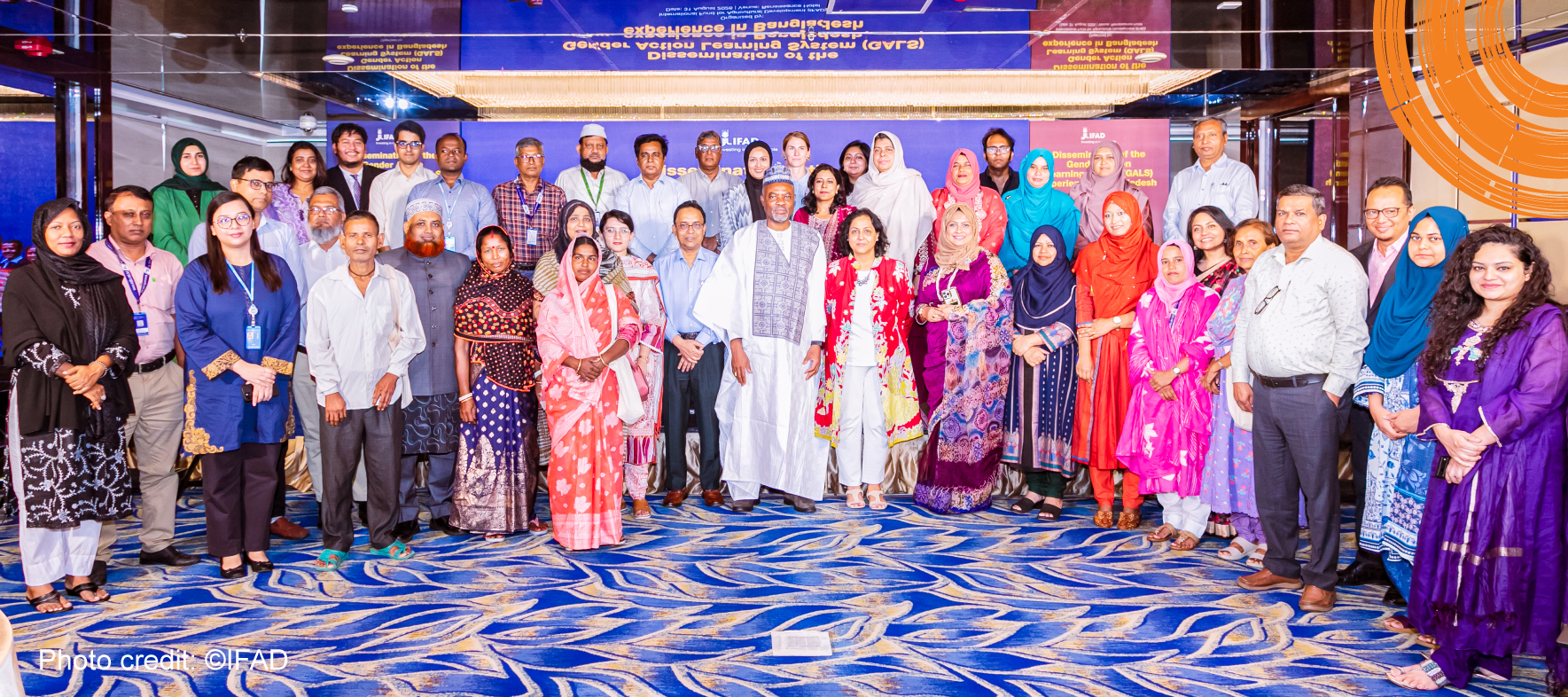
IFAD commissioned the study From Practice to Policy: Scaling Gender Action Learning Systems (GALS) and PATH in Bangladesh to consolidate evidence from the IFAD-financed Promoting Resilience of Vulnerable through Access to Infrastructure, Improved Skills and Information (PROVATi³) project, implemented by the Local Government Engineering Department (LGED), and to build the case for scaling the approach. Innovision presented the findings at a dissemination event organized by IFAD in Dhaka on 31 August 2026, where government counterparts, development partners and programme participants reflected on what Bangladesh has learned and what national scale-up would require.
A road or market project can raise a household's income without changing who makes decisions at home or how the money is spent. Programmes that work with women alone can meet resistance from husbands or leave women with a heavier workload. GALS and PATH take a different route: they train husbands and wives together, so that they plan together and each can see the other's contribution.
The evidence is encouraging. Among participating households, women's control over their own earnings rose from 35 to 96 per cent, and women's mobility increased from 44 to 91 per cent.
GALS is a community-led method, used in more than 26 countries, that relies on drawings and simple visual tools, making it accessible across literacy levels.. Couples map out their goals, income and daily workload together, then plan how to reach those goals. Its Vision Journey helps a household picture the future it wants, and the steps to get there, while the Gender Balance Tree shows who does what in a day, including unpaid domestic and care work that often goes unrecognized .
PATH evolved from GALS within PROVATi³, after the project found that visioning alone was not enough to sustain change. It retains all five GALS principles and adds structured coaching, milestone tracking and household budgeting, so that plans turn into measurable progress. IFAD's 2025 supervision mission endorsed it as a scalable model.
The fieldwork in Kurigram, Gaibandha and Nilphamari showed what this looks like in daily life. Families described a consistent pathway out of poverty, moving from wage labour to savings,then to livestock, small businesses, land and better housing. In Rajarhat, average monthly household incomes rose from BDT 5,000-7,000 to BDT 12,000-13,000. Borrowing shifted from survival to investment, with loan sizes growing from BDT 20,000-30,000 for consumption to BDT 100,000-150,000 for productive purposes, often used to fund Vision Journey milestones. Couples now budget together, and several male participants have taken on cooking, childcare and other household work after seeing the full extent of their wives' contribution. Some households once criticised for letting women work outside the home are now trusted sources of advice, and in several areas participants have acted together to prevent child marriages.
The approach began as a pilot under the Coastal Climate Resilient Infrastructure Project and was institutionalised under PROVATi³ from 2018. It reached households of Labour Contracting Societies (LCS), whose members earn wages building roads and markets. Project evidence shows that 7,747 of 8,572 targeted households were reached, about 95 percent of couples trained together, and around 70 percent of households achieved part or all of their vision.
Change went well beyond household income. Decision-making shifted from male-dominated to joint across all study sites, and couples now plan and budget together, increasingly including young people in household planning. Many male participants described the Gender Balance Tree as the moment they recognized the full value of their wives' unpaid work, and several have since taken on cooking, childcare and other household tasks. Some households once criticized for letting women work outside the home are now trusted sources of advice, and in several communities participants have acted together to prevent child marriages.
GALS is already moving beyond a single project. A locally adapted GALS manual has been submitted to the Ministry, LGED is working to make GALS/PATH a mandatory requirement in its project proposal process, and it plans to include GALS in foundational training for incoming engineers and consultants. The Eco-Social Development Organization (ESDO), the training provider, has embedded GALS tools across more than 150 projects in 356 upazilas.
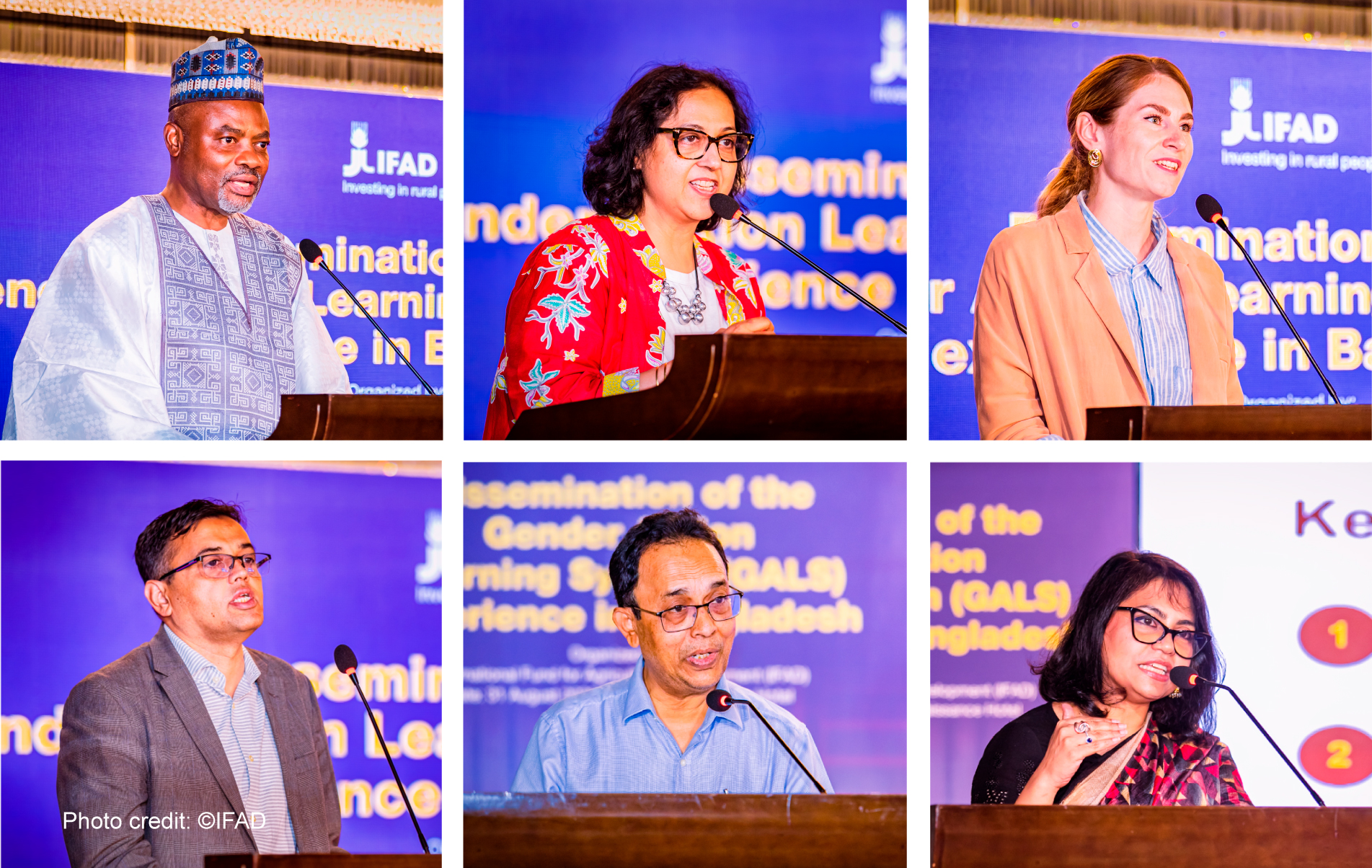
The dissemination event, held at the Renaissance Hotel in Gulshan, Dhaka, brought together Valantine Achancho, IFAD Country Director for Bangladesh, and Reehana Raza, IFAD Regional Director for Asia and the Pacific, with representatives of the Local Government Division, LGED, the Economic Relations Division, other government agencies, PROVATi³ staff and development partners. Ojongetakah Enokenwa Baa, Team Lead of the study, presented the findings, and Tasmiah Rahman, Portfolio Director at Innovision, presented the policy brief on behalf of Sinora Chakma.
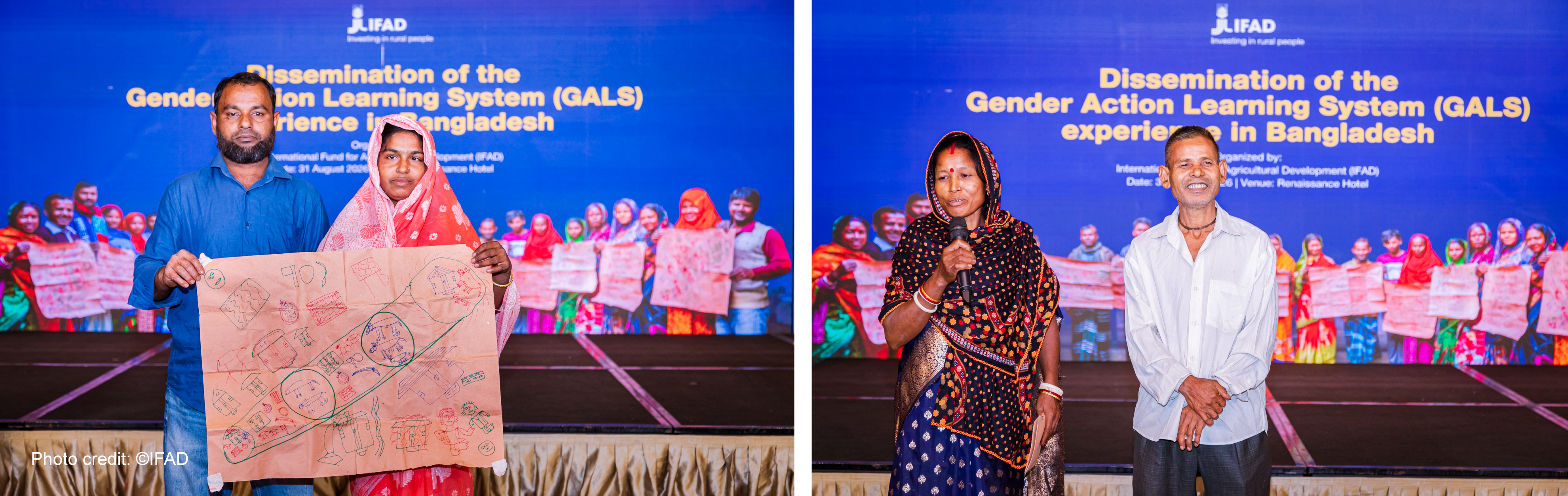
Two families who took part in GALS travelled from Kurigram and Dimla to share their own experiences.
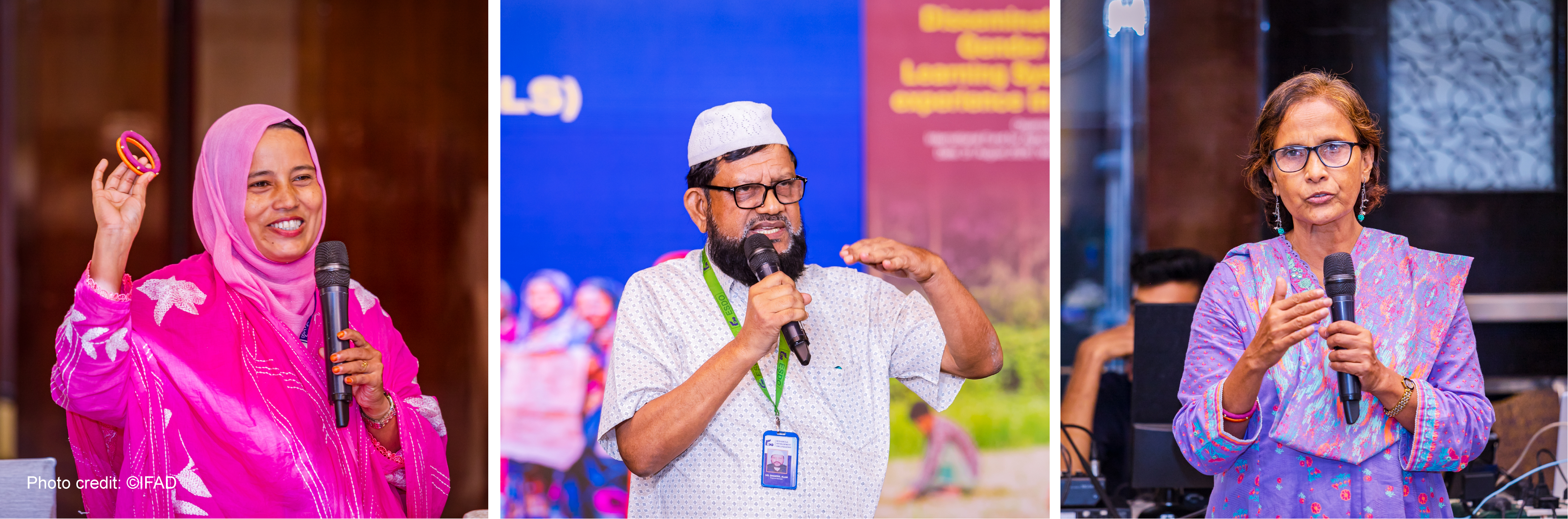
An open discussion then tested the findings against real experience. Trainers recalled doubting that a drawing-based method would work for construction workers, and were surprised by how clearly participants planned. A training coordinator from the Eco-Social Development Organization (ESDO) proposed formally recognising the around forty women champions and practitioners trained over four years and documenting their journeys in a "champion book" to support scale-up. The LGED Chief Engineer said the study should mark the start of institutionalising these lessons rather thanthe end of a project, and shared that LGED is already carrying PATH into a new project and setting up a unit on climate resilience and disaster recovery. The LGED Chief Engineer said the study should mark the start of institutionalizing these lessons rather than the end of a project and shared that LGED is already carrying PATH into a new project and establishing a unit on climate resilience and disaster recovery.
Participants also raised questions about grievance redress, protection from gender-based violence and equal pay, and a gender specialist noted that deep social change often takes ten to fifteen years. The PROVATi³ team explained that workers can raise grievances through a multi-tier committee system or a hotline, that LGED-built markets have separate toilets for women and men, and that LCS work follows equal pay for equal work.
The study sets out a clear agenda for moving GALS and PATH from a project-level intervention to national scale, with shared roles for IFAD, LGED, the Government and partners. First, institutionalize the approach by embedding it in LGED's operational guidelines, implementation manuals, budget lines and accountability systems, and in IFAD's Country Strategic Opportunities Programme and future project designs, so that gender transformation is built into rural infrastructure, climate resilience, finance and market-development investments from the outset. Second, sustain coaching through a tiered system of certified master trainers, regional facilitators and community champions, with post-training coaching and monitoring treated as a budgeted, contractually mandated function for at least two years after project closure.
The study sets out a clear agenda for moving GALS and PATH from a project-level intervention to national scale, with shared roles for IFAD, LGED, the Government and partners. First, institutionalize the approach by embedding it in LGED's operational guidelines, implementation manuals, budget lines and accountability systems, and in IFAD's Country Strategic Opportunities Programme and future project designs, so that gender transformation is built into rural infrastructure, climate resilience, finance and market-development investments from the outset. Second, sustain coaching through a tiered system of certified master trainers, regional facilitators and community champions, with post-training coaching and monitoring treated as a budgeted, contractually mandated function for at least two years after project closure.
Third, ensure no one is left behind through a differentiated pathway for households that cannot follow the standard progression, including women-headed households, landless households, households carrying significant debt or experiencing extreme poverty, and households with members living with disabilities, alongside psychosocial support, attention to safety as women's mobility grows and shock-responsive support to protect hard-won gains. Fourth, connect and protect household gains by linking participants to markets, finance and enterprise support, integrating climate-smart livelihood planning and disaster preparedness, and digitizing monitoring through LGED and Department of Disaster Management systems. Underpinning all four is a sustainable blended financing model that combines public budgets, donor financing and mechanisms such as social protection linkages, together with stronger evidence from a comparison group, long-term follow-up and a costing exercise for national scale-up.
The discussion in Dhaka showed strong support for the approach, alongside practical questions on safety and equity that should shape its next phase. With a locally adapted manual submitted to the Government and LGED already carrying PATH into new investments, the conditions are in place for GALS and PATH to reach national scale, provided the coaching, financing and inclusion gaps identified in the study are addressed. Bangladesh's experience also offers a reference model that IFAD, governments and development partners elsewhere can learn from.
We thank IFAD, the Local Government Division, LGED, the PROVATi³ team, ESDO and, above all, the women and men who shared their experiences with us.
.png)