Bangladesh votes twice this year. The first ballot, on 12 February, is behind it. The second, local government elections expected to begin in October, is still ahead, and almost everything documented about the information environment around the first vote suggests the second needs far more preparation than it is currently getting, or it risks repeating the same problems at a more local, less-scrutinized scale. At the center of that problem sits hate speech, communication that, under the UN’s own working definition, attacks or demeans a person or group not for what they’ve done or argued, but for who they are: their religion, ethnicity, gender, or political identity.[1] What has shifted in Bangladesh’s current electoral cycle isn’t the existence of that kind of speech, which has always accompanied Bangladeshi politics; it’s the delivery mechanism. Misinformation and disinformation, especially fabricated videos, AI-generated clips, and doctored images, now carry dehumanizing framing further, faster, and more convincingly than speech alone ever could, reaching audiences before any correction has a chance to catch up. That shift, hate speech riding on the back of engineered falsehoods, is why acting now, well before October, matters more than reviewing what went wrong afterward.
The two terms doing the carrying are not interchangeable, and the distinction matters for how each gets tackled. UNESCO defines disinformation as false information deliberately created to harm a person, group, organization, or country, and misinformation as false information that is also untrue but shared without any intention to cause harm, typically by ordinary users who believe it and pass it along.[2] Disinformation is the deliberate weapon: someone builds a fabricated video or doctored quote with a specific target and a specific outcome in mind. Misinformation is the delivery system that gives it scale: once that fabricated content is released, it spreads largely through people who have no deceptive intent at all, a relative, a neighbour, a fellow party supporter who simply believes what they’re forwarding. The link to hate speech runs directly through this pairing. A dehumanizing claim about a candidate’s religion, gender, or loyalty rarely spreads on its rhetorical strength alone; it spreads because it arrives dressed as a fact, a video, a screenshot, a quote, that looks verifiable enough to share without checking. Disinformation supplies the false factual predicate; misinformation supplies the reach; hate speech supplies the emotional charge that makes people want to pass it on in the first place. Strip out any one piece, and the other two lose most of their power, which is also, as the final section of this piece lays out, exactly where interventions are aimed.
Bangladesh’s 12 February 2026 parliamentary election, the first since the July 2024 uprising, was, by multiple independent accounts, awash in engineered falsehoods well before polling day. Interim leader Muhammad Yunus told the UN human rights chief in January 2026 that the country was contending with a “flood of misinformation” coming from both foreign and domestic sources.[3] AFP’s fact-checking teams documented hundreds of AI-generated videos circulating on Facebook, TikTok, YouTube and Instagram in the run-up to the vote, most without any AI disclosure label, among them a synthetic video of a woman appearing to campaign against a leading party, and another fabricated clip threatening religious-minority voters with exile if they didn’t vote a particular way. The US-based Center for the Study of Organized Hate separately tracked more than 700,000 posts from over 170,000 X accounts making unverified claims of mass violence against Hindus in Bangladesh between August 2024 and January 2026, assessing that more than 90 percent of that content originated in India, with the remainder tied to Hindu-nationalist networks in the UK, US, and Canada, even as Bangladeshi police figures for the same period told a different story on the ground: of 645 incidents involving minority communities in 2025, only 12 percent were classified as having a sectarian motive.[4] That gap, between the online narrative and the documented reality, is itself worth sitting with.
Domestic monitoring told a parallel story. The Daily Star built and manually verified a politically-blind watchlist of 615 Facebook pages and profiles known for spreading disinformation and hate speech, and in a single month spanning mid-December 2025 to mid-January 2026 documented 220 distinct cases of disinformation traceable to party-aligned actors, with accounts aligned to a specific political party responsible for nearly half of that volume in the sample period.[5] Dismislab, an independent Dhaka-based fact-checking initiative, recorded that verified misinformation in Bangladesh rose by roughly 30 percent in 2025 over the prior year, and worked directly with BBC News Bangla to debunk fabricated claims about attacks on religious minorities.[6] A separate quantitative review by Insights Bangladesh’s research division documented 2,402 verified misinformation cases between January and April 2026 alone, including 416 distinct instances of AI-generated content and a pattern of bad actors impersonating the visual identity of established broadcasters such as Jamuna TV and NTV to lend false credibility to fabricated claims.[7]
None of this infrastructure, the networks, the templates, the AI tools, the audiences already primed to share this material, disappears because a national election has concluded. It simply waits for its next target.
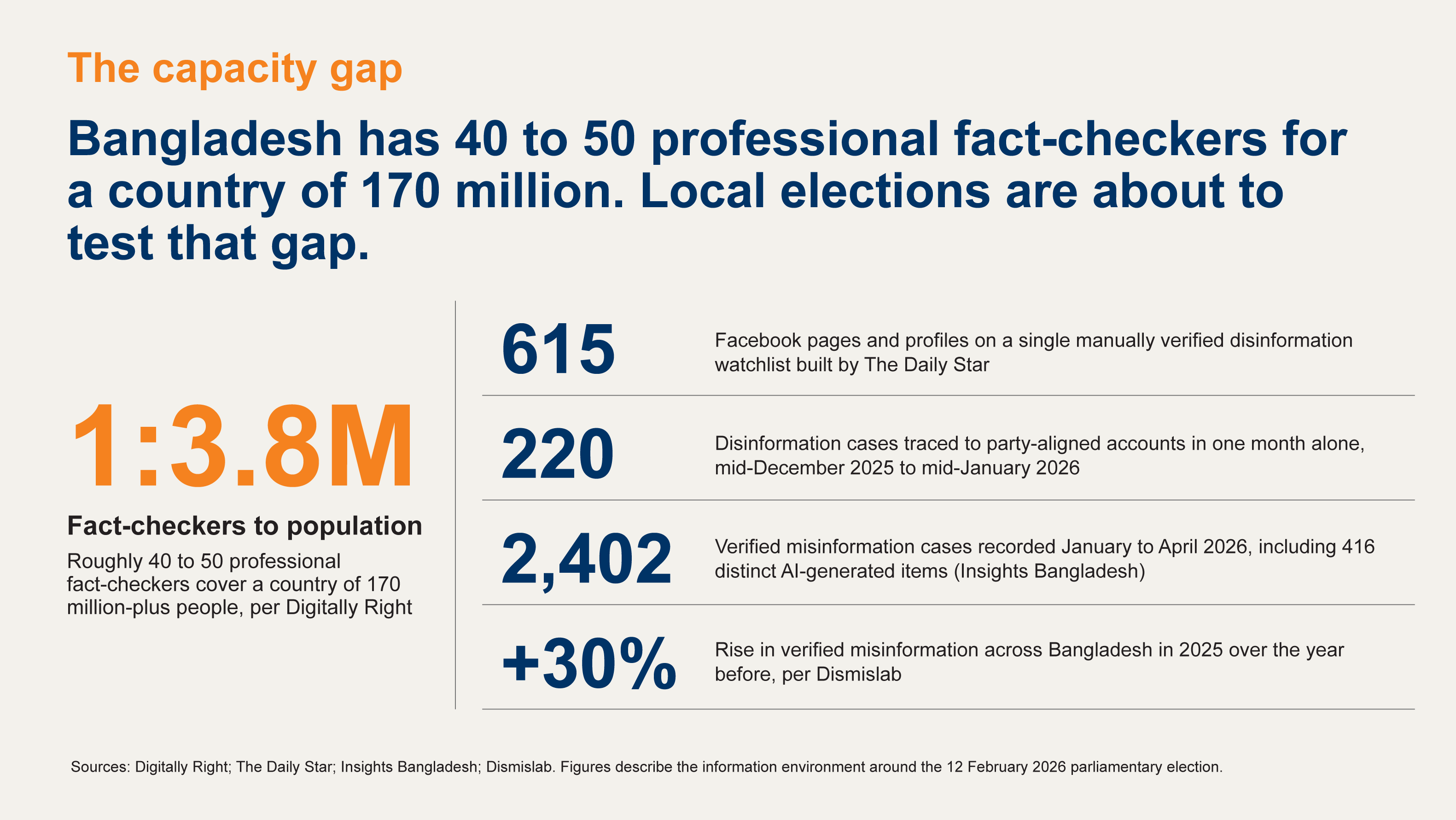
Dhaka-based digital rights organization Digitally Right, in a study published ahead of the February vote with support from The Asia Foundation and the UK’s FCDO, warned that Bangladesh’s capacity to respond to this threat is dangerously thin: the country has only 40 to 50 professional fact-checkers for a population of over 170 million, most mainstream outlets lack dedicated verification desks, and the country’s Election Commission still lacks the policy framework and institutional capacity to respond effectively, a gap the report’s own framing called dangerously wide.[8] That gap does not close between February and October. If anything, local elections stretch it further, because they multiply the number of contests, thousands of union parishad seats nationwide rather than 300 parliamentary ones, while national media and international attention, which supplied some scrutiny during the February vote, typically fade for local races.
There is also a historical pattern specific to local government elections that deserves attention on its own terms. When Bangladesh first introduced partisan local government elections in 2015, the 2016 Union Parishad elections that followed set a grim record: 116 deaths, according to post-election analysis, alongside widespread allegations of rigging and an Election Commission criticized for inaction.[9] Crisis monitoring group ACLED separately recorded 263 distinct incidents of political violence and protest during that election period, an average of 25 events per week, roughly double the average rate of 12 events per week recorded outside the election window.[10]
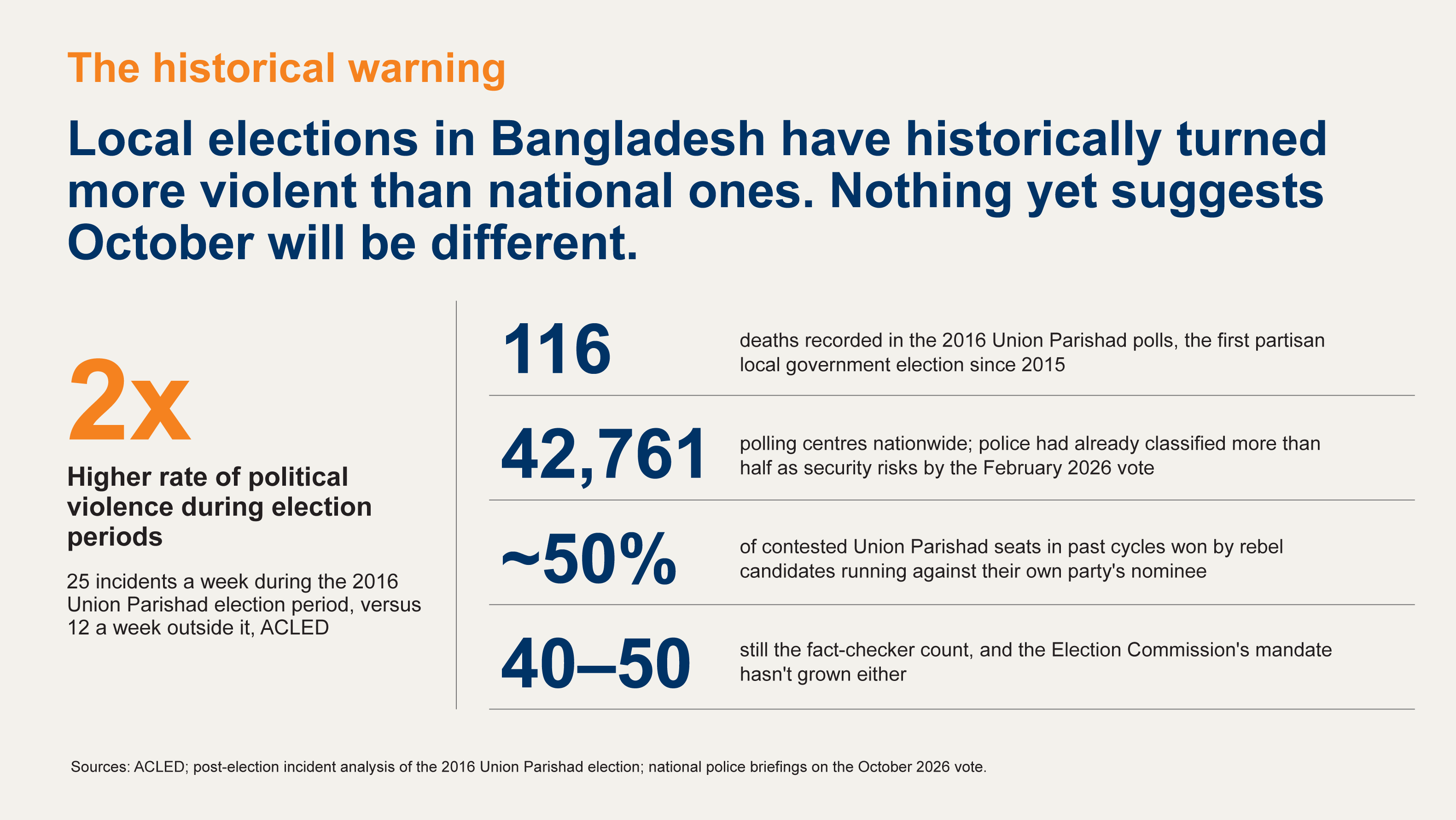
Local elections in Bangladesh also carry a distinct fault line that national elections don’t: intra-party rivalry. Because local nominations are contested closely within parties as well as between them, rebel candidates running against their own party’s official nominee have, in past Union Parishad cycles, won close to half of all contested seats, meaning local races generate friction along additional lines that a national election, dominated by cross-party contests, does not.[11]
Put together, the justification is straightforward: the same disinformation-production apparatus documented in exhaustive detail during the February election remains fully operational; the country’s verification capacity has not meaningfully grown to meet it; and local elections have historically produced higher rates of violence than national ones, driven by hyperlocal and intra-party rivalries that a national campaign doesn’t generate. There is no reason internal to Bangladesh’s information environment or its electoral history to expect October to be calmer than February. There is good reason, on current evidence, to expect the opposite unless the gap Digitally Right identified is deliberately closed beforehand.
It’s tempting to picture this as a single causal arrow: hate speech online, violence offline. The documented pattern in Bangladesh is messier and, in some ways, more concerning: online and offline dynamics feed each other in both directions, sometimes without either side needing the other to be factually accurate. The reverse direction, offline reality generating online distortion, sometimes far exceeding what happened on the ground, is just as well documented. Build Up, a peacebuilding organization that monitored the full electoral cycle, found that claims of violence and massacre were among the most-shared harmful narratives of the entire electoral period, accumulating over 16,000 posts and roughly 5 million comments, and that these claims did not necessarily reflect the actual security situation; they nonetheless shaped a public perception of insecurity, particularly around election announcements.[12] That matters because perceived insecurity is not a passive byproduct: it can suppress turnout among precisely the groups already reluctant to participate, women and minority candidates chief among them, turning an online exaggeration into an offline outcome (lower participation, quieter withdrawal from public life) that then looks, to observers, like confirmation that the original claim was true.
A third loop runs through the diaspora.The information environment, in other words, doesn’t stay contained inside Bangladesh’s borders in either direction: it draws on international amplification, including the cross-border networks from India documented by the Center for the Study of Organized Hate, and diaspora engagement abroad, both of which loop back to shape what happens inside the country.
For October, this nexus is the reason a narrow focus on “will there be violence at polling stations” undersells the risk. The loop operates well before and beyond the ballot itself: online narratives about a local candidate, true or fabricated, can suppress candidacy or turnout without a single offline incident; an offline dispute between two local factions can be captured, edited, and recirculated online in a way that inflames a hundred other constituencies that had no connection to the original event; and international or diaspora actors with no stake in a specific union parishad race can still shape how that race is perceived by the people voting in it.
Build Up's monitoring, covering roughly 499,000 social media posts across Facebook, TikTok, and X between August 2025 and February 2026, found that hate speech was the single most common digital harm in Bangladesh's political discourse. It made up 8 percent of all classified posts. The language had become normalized enough to function as a routine part of political argument, not an exception to it. One recurring pattern used delegitimizing labels to recast political opponents as enemies of the state. A second consisted of religious and communal hate speech aimed at minority communities, spiking around religious festivals and identity controversies. This is the opinion-shaping mechanism in practice. Repeating a delegitimizing label stops functioning as an argument that has to be evaluated. Over time, it's simply absorbed as a fact about who the target is.
The same monitoring found that incitement to violence, while the smallest harm category by volume, spiked sharply around specific moments of acute political shock. Accumulated online anger turned into explicit calls for confrontation. In some cases, mob action got framed as a legitimate political response. That pattern showed up in independent risk assessments too. One briefing noted that violence against political figures rose sharply from December 2025 onward, and that police had already classified more than half the country's 42,761 polling centres as security risks requiring reinforced protection.[13] A police official quoted by Al Jazeera during the campaign accused one party of spreading online disinformation that was already spilling into offline confrontations, warning that any public perception of a "managed" election would deepen the risk of violence.[14] A separate risk assessment concluded the security environment was likely to deteriorate further during the election period, citing entrenched political and religious tensions.[15]
That's a serious claim, and it deserves an equally honest caveat. Despite six months of sustained polarization, Build Up's own assessment was that the 12 February election was largely peaceful and procedurally orderly. Online discourse functioned less as a mirror of Bangladeshi public sentiment than as an amplifier of perceived instability, driven disproportionately by a small number of highly organized accounts rather than ordinary citizens. Just as importantly, the single largest narrative category recorded across the whole monitoring period wasn't hateful at all. It was constructive: posts calling for calm, tolerance, and national unity outnumbered any individual harmful theme. That's evidence of a real, sustained civil-society effort to stabilize the information environment, even while organized actors pushed the other way. Leaving that fact out risks overstating inevitability and understating the agency of the people actively working against it.
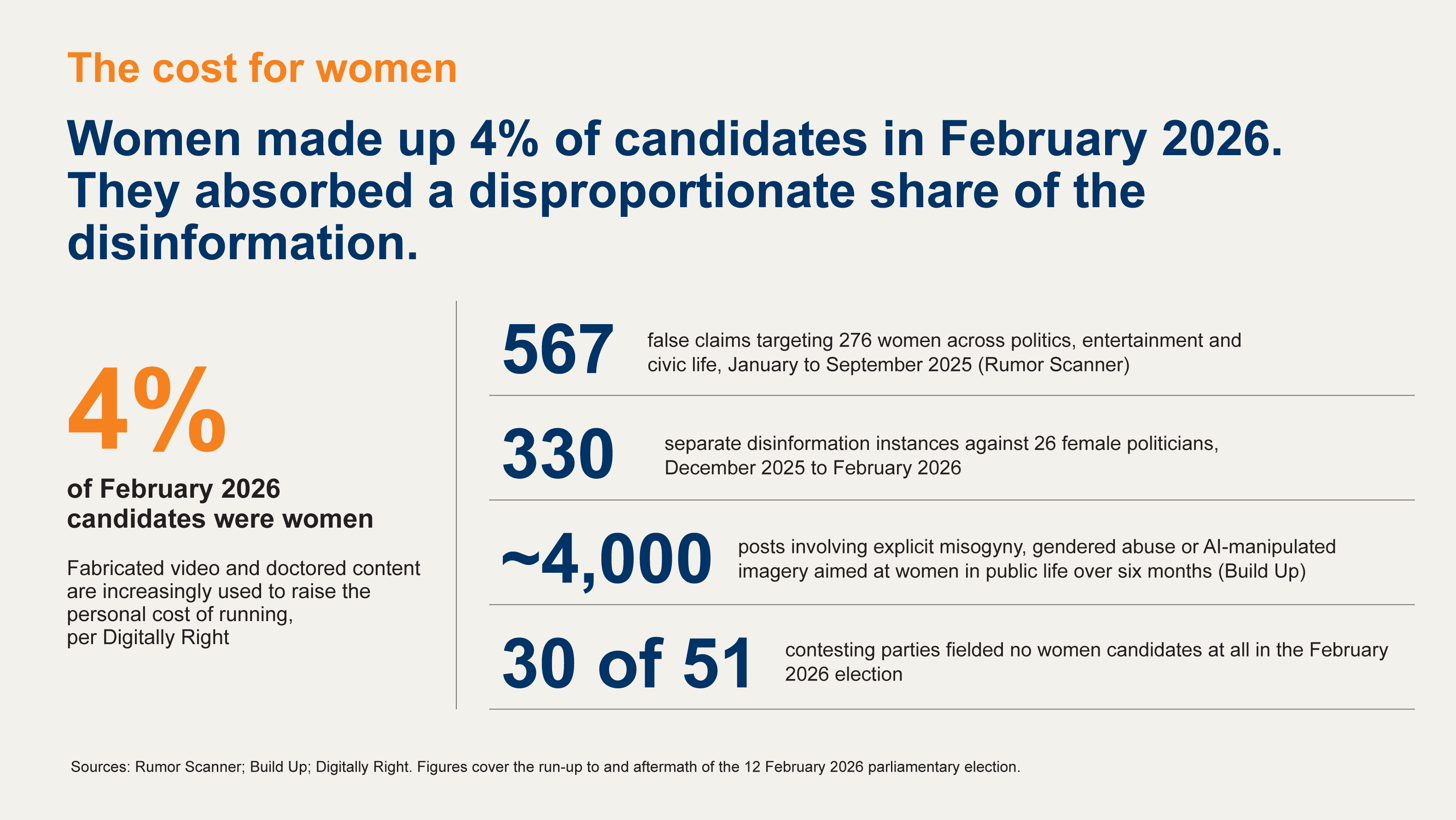
Everything above describes a pattern affecting political figures broadly. Women running for office carry an additional, compounding version of it. Representation is the starting problem. Women made up only about 4 percent of candidates in the February 2026 election. Thirty of the 51 contesting parties fielded no women candidates at all.[16] The harassment aimed at the small number who do run has a distinct character: sexualized, and increasingly synthetic. Digitally Right's pre-election study found that disinformation had moved beyond ordinary political rivalry into something closer to a silencing tool, with fabricated videos and doctored content specifically targeting women candidates and minority communities to raise the personal cost of running.
The numbers back that up. Rumor Scanner recorded 567 false claims targeting 276 women across politics, entertainment, and civic life between January and September 2025, including doctored videos and sexualized fabrications aimed at senior political figures.[17] A follow-up review, December 2025 through February 2026, documented 330 separate disinformation instances against 26 female politicians.[18] Build Up's monitoring quantified the digital dimension of this specifically: roughly 4,000 posts involving explicit misogyny, gendered abuse, and AI-manipulated imagery aimed at women in public life over the same six-month window. For a woman weighing whether to run for a union parishad seat this October, that's a cost she has to pay before her name is even on the ballot.
None of this happens by accident. Three specific forces are driving it, and they reinforce each other.
Everything documented above points toward the same conclusion: the response so far has been reactive, fragmented, and outmatched by the scale of the problem. Closing that gap before October, rather than reviewing it again afterward, means action on five fronts.
None of this guarantees October will be calmer than February. But it replaces a wait-and-see posture with a specific list of who needs to act and what they need to do, which is more than Bangladesh had going into its last vote.
[1] United Nations, “United Nations Strategy and Plan of Action on Hate Speech,” launched 18 June 2019; working definition as cited by UNESCO, “What you need to know about hate speech.” https://www.un.org/en/hate-speech/un-strategy-and-plan-of-action-on-hate-speech ; https://www.unesco.org/en/countering-hate-speech/need-know
[2] UNESCO, “What is Disinformation? Meaning, Definition” and “What is Misinformation? Meaning, Definition.” https://www.unesco.org/en/query-list/d/disinformation ; https://www.unesco.org/en/query-list/m/misinformation
[3] AFP, republished as “‘Flood’ of disinformation ahead of Bangladesh election,” 9 February 2026. https://www.malaymail.com/news/world/2026/02/09/coordinated-indian-ai-disinformation-including-hindu-genocide-claims-threatens-bangladesh-elections/208558 ; also The Daily Star, “‘Flood’ of disinformation, mostly from India, ahead of Bangladesh election,” 10 February 2026. https://www.thedailystar.net/news/national-election-2026/disinformationmisinformation/news/flood-disinformation-mostly-india-ahead-bangladesh-election-4102701
[4] Center for the Study of Organized Hate, findings reported in Digital Journal, “‘Flood’ of disinformation ahead of Bangladesh election,” 9 February 2026. https://www.digitaljournal.com/world/flood-of-disinformation-ahead-of-bangladesh-election/article
[5] Dawn.com (citing The Daily Star’s original watchlist analysis), “Bangladesh election: Disinformation swarms social media,” 11 February 2026. https://www.dawn.com/news/1972525/bangladesh-election-disinformation-swarms-social-media
[6] Wikipedia, “Dismislab,” citing The Straits Times, “Misinformation in Bangladesh Rose by 30% in 2025,” 15 August 2025, and The Daily Star, “Attacks on Minorities: BBC, Dismislab Debunk Fake News,” 10 June 2024. https://en.wikipedia.org/wiki/Dismislab
[7] Insights Bangladesh Research & Media Intelligence Division, “The 2026 Electoral Information Crisis: A Quantitative Analysis of AI-Generated Misinformation and Media Impersonation in Bangladesh,” 8 May 2026. https://www.researchgate.net/publication/404659494_The_2026_Electoral_Information_Crisis_A_Quantitative_Analysis_of_AI-Generated_Misinformation_and_Media_Impersonation_in_Bangladesh
[8] Digitally Right, “Tackling Election Disinformation in Bangladesh: Building Collective Responses for Electoral Integrity,” reported in The Daily Star, “Bangladesh faces rising misinformation threat ahead of 2026 polls: Study,” 2 November 2025. https://www.thedailystar.net/news/bangladesh/elections/news/bangladesh-faces-rising-misinformation-threat-ahead-2026-polls-study
[9] Saiful Islam and Md. Asaduzzaman Mondol Asad, “An Analysis of Two Local Government Elections Based on Party Affiliation in Bangladesh,” Journal of Social Science, Faculty of Social Sciences, Begum Rokeya University, Rangpur, Vol. 7, No. 1 (July 2024), pp. 184–200. https://brur.ac.bd/storage/publishJournal/2025/Mar/an-analysis-of-two-l…_1742279016_200.pdf
[10] ACLED, “Electoral Violence in South Asia: Local Elections in West Bengal & Bangladesh.” https://www.crisis.acleddata.com/electoral-violence-in-south-asia-local-elections-in-west-bengal-bangladesh/
[11] “Discipline, Development, and Duress: The Art of Winning an Election in Bangladesh,” Japanese Journal of Political Science / Taylor & Francis. https://www.tandfonline.com/doi/full/10.1080/14672715.2023.2229363
[12] Build Up, “Understanding Harmful Digital Narratives and Behaviours ahead of the 2026 Bangladesh Elections,” 14 April 2026. https://howtobuildup.org/understanding-harmful-digital-narratives-and-behaviours-ahead-of-the-2026-bangladesh-elections/
[13] Healix, “Bangladesh’s 2026 election: What you need to know,” 15 January 2026. https://healix.com/international/insights/blog/bangladeshs-2026-election-briefing
[14] Al Jazeera, “‘Frightening situation’: Bangladesh elections haunted by political violence,” 27 January 2026. https://www.aljazeera.com/features/2026/1/27/fear-and-hope-in-bangladesh-how-political-violence-is-haunting-elections
[15] Solace Global, “Bangladesh Elections Held Amid High Violence Risk,” 10 February 2026. https://www.solaceglobal.com/news/2026/02/10/election-guide-bangladesh-2026/
[16] fundsforNGOs News, “Bangladesh Faces Surge in Violence Against Women, Girls, and Minorities Ahead of Elections,” 15 January 2026. https://news.fundsforngos.org/2026/01/15/bangladesh-faces-surge-in-violence-against-women-girls-and-minorities-ahead-of-elections/
[17] Prothom Alo, “Disinformation and misinformation: The battle for truth in post-uprising Bangladesh,” 13 October 2025. https://en.prothomalo.com/opinion/op-ed/k6vdgpo7rk
[18] Rumor Scanner, “Disinformation Targets Women: Politicians and Actresses in the Crosshairs,” 8 March 2026. https://rumorscanner.com/en/statistics-2/women-disinformation-trends-december-to-january/198067
Author: Nayem Ahmed Siddik, a Senior Associate in the Gender and Basic Services Portfolio at Innovision Consulting
.png)