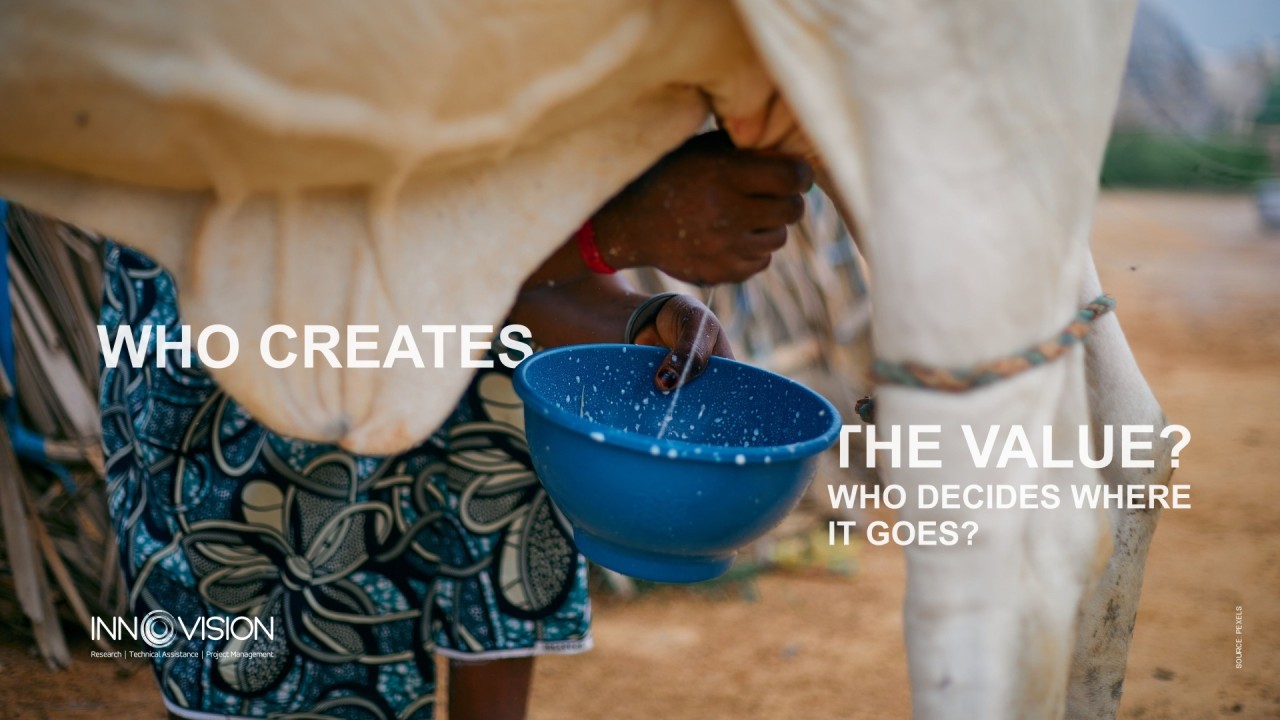
A woman may spend her day feeding livestock, processing milk, caring for children, and contributing to household income. Yet across Nigeria's livestock value chain, nearly four out of every five stakeholders are men. This is the paradox at the heart of women's inclusion in livestock.
Despite their contributions to production, processing, and household livelihoods, women remain underrepresented in the opportunities and structures that shape economic outcomes.
The issue is not whether women participate. They already do. The question is whether their participation translates into ownership, market access, income, and decision-making power. The evidence suggests it often does not. This reality is particularly evident in Nigeria's dairy economy.
Consider the role of many Fulani women within the livestock system. While they may not be visible in livestock markets or interstate trading networks, they are often central to the production and processing of dairy products that sustain household incomes and local food systems. Their contribution illustrates a broader reality: women are deeply embedded in the value chain, but often in segments that generate less visibility, influence, and economic control.
While men dominate cattle husbandry and livestock trading, women are concentrated in milk production and processing. Evidence from the sector shows that 92% of men are active in cattle husbandry, while 83% of women are involved in milk-related activities. A significant share of Nigeria's raw milk is traded or processed informally by Fulani women into local dairy products that support households and local markets.
Yet the value chain remains segmented along gender lines.
Men largely occupy roles such as brokers, traders, retailers, and processors of hides and skins. Women are concentrated in dairy processing, livestock maintenance, and food vending. Even when women participate in local market sales, they often do so through male intermediaries. Their involvement in inter-state livestock trade remains limited.
The challenge becomes even more apparent when we examine asset ownership.
At first glance, the findings suggest encouraging levels of agency. Nearly 78% of women surveyed acquired livestock by purchasing animals themselves from the market, compared to 27% who inherited livestock and 12% who received livestock as marriage gifts. These figures challenge the assumption that women are merely beneficiaries within livestock systems. Many are actively investing in productive assets.
But ownership does not always translate into control.
In many households, livestock owned by women become part of family herds managed by male relatives. Women may possess assets without having full authority over how those assets are used, sold, or reinvested. The distinction between ownership and decision-making remains one of the most important barriers to women's economic progress within the sector.
The type of livestock women own also tells an important story.
Rather than cattle, many women prefer smaller ruminants such as goats and sheep. These animals require less capital, reproduce faster, and can be sold quickly to meet household needs. Among respondents, 76% reported owning Red Sokoto goats, a breed valued for its ability to reproduce within six months and generate income more rapidly.
For many women, these animals are not just livestock. They are accessible financial assets and household resilience mechanisms, a practical adaptation to a system that limits their entry into higher-value segments of the chain.
This pattern points to something larger than individual choices.
The gender segmentation of Nigeria's livestock value chain is reinforced by longstanding social norms, market structures, and cultural practices that shape who participates in different parts of the value chain. In markets across Ogun State, for instance, women are reportedly excluded from livestock trading on cultural grounds, while men continue to dominate the higher-value activities of trading, brokerage, and market intermediation.
The result is a system where women contribute significantly to production but remain less visible in the segments where commercial influence, market power, and economic returns are concentrated.
Closing that gap will require more than awareness campaigns.
Women need fair access to credit, direct market participation without male intermediaries, and greater control over the income their labour generates. Training in veterinary services, which the sector urgently lacks, is one area where women's existing proximity to household livestock gives them a practical foundation to build on. Technology access, including basic milking equipment, could reduce the physical burden that compounds their already unbalanced workload.
But none of these interventions will hold without addressing the core issue.
Women's inclusion cannot be measured by participation alone. The real question is whether participation translates into agency, ownership, market access, and decision-making power. Where men retain control over the income women generate, inclusion becomes performance rather than progress.
When women gain genuine influence over assets, income, and decisions, the benefits extend beyond the livestock sector. Households are stronger, children are better fed and educated, and communities become more economically resilient.
The future of Nigeria's livestock sector depends not only on who participates, but on who has the opportunity to thrive.
At Innovision Consulting Africa, we work with development partners, foundations, governments, and private sector actors to generate evidence, design inclusive market systems interventions, and translate research into actionable insights.
If your organisation is exploring gender inclusion, market systems development, value chain transformation, or evidence-based programme design, we'd love to connect. Reach out to us at info@innovision-bd.com.
Source: Adapted from a synthesis of evidence on women's inclusion in Nigeria's livestock value chain prepared by Innovision Consulting Africa for Heifer International Nigeria.
Author: Chisom Udora, Economic Growth Lead, Innovision Consulting Africa
.png)