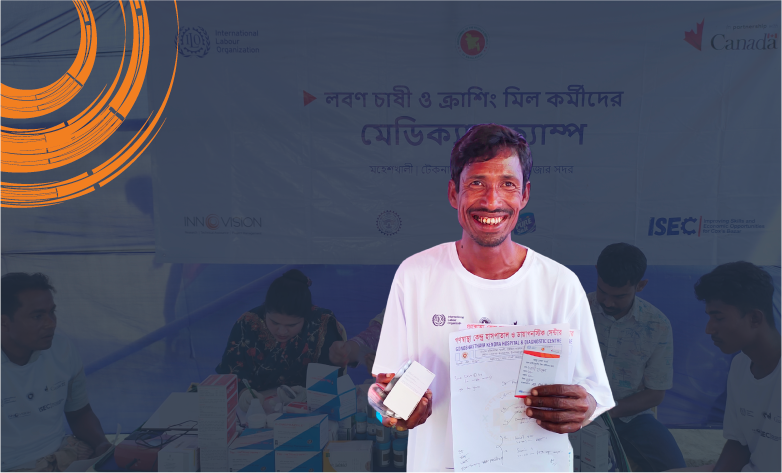
Every year on May 1st, statements are issued, promises are repeated and banners are raised. And every year, millions of workers the day still begins the same way - too early, too tired, and too exposed to risks they did not create.
The real gap is simple. It is the distance between what policies promise and what workers actually feel on the factory floor, in the field, or at home-based workplaces.
International Workers' Day 2026 arrives at a moment when that gap is harder to ignore. Laws are tightening, investors are asking harder questions, and brands can no longer treat labour conditions as a side issue. Yet for many workers, daily reality has barely changed.
Understanding why this gap persists, and what closing it actually requires, is the starting point for any serious intervention in labour rights and worker wellbeing.
May Day began as a demand for the eight-hour workday. However, the truth is for many workers, May Day is not a celebration of progress. It is a reminder of how unfinished the work still is. More than a century later, it has become a global accountability moment, a day when the distance between policy and lived reality becomes visible.
In 2026, that visibility carries new weight. The EU CSDDD means supplier labour standards are now a legal and financial risk, not just a reputational one. Institutional investors increasingly require evidence of social impact, not just disclosure. And turnover in garment, footwear, and manufacturing sectors has reached levels that directly threaten productivity and delivery timelines. Decent work is increasingly inseparable from supply chain reliability.
International Workers' Day is not a ceremonial occasion. It is a forcing function, a moment to ask whether investments made in the name of worker wellbeing are actually working.
1. The Compliance Trap
When violations trigger penalties, factories conceal hazards rather than correct them. Supervisors manage audit visits rather than manage safety. The audit ends up measuring a factory's capacity to pass audits, which is a very different thing from measuring worker safety. Self-reported near-miss rates, one of the most reliable leading indicators of accident risk, are consistently suppressed in high-audit environments.
2. The Invisible Workforce
Formal frameworks typically cover registered, Tier-1 facilities. But home-based piece-rate workers, subcontracted labourers, and workers in informal processing and agricultural supply chains sit entirely outside them. In Bangladesh alone, millions of workers in sectors including salt processing, shrimp peeling, and brick kilning face significant occupational health risks with virtually no institutional protection. These informal workers carry the same risks, but without the minimum protections that formal workers at least have on paper.
3. Gender-Blind Design
Women comprise the majority of workers in labour-intensive export industries, yet standard OSH programmes are rarely designed with them in mind. Ergonomic hazards differ. Reproductive health risks go unaddressed. Psychosocial risks, including harassment and the burden of unpaid care work, affect women workers at higher rates and with different patterns. A programme that does not account for these differences is not gender-neutral. Moreover, A programme may look gender-neutral on paper, while ignoring the fact that a woman worker may stand for ten hours, manage unpaid care before and after work, and still have no safe channel to report harassment.
4. Weak Evidence and Fragmented Measurement
Output tracking dominates: workers trained, factories assessed, policies revised. Training 500 workers means very little if injuries do not fall and workers still feel unsafe speaking up. Outcome measurement, whether injuries declined, whether hazard reporting increased, whether worker voice improved, is less common and less funded. Without credible outcome data, investment continues to flow toward familiar models rather than effective ones.
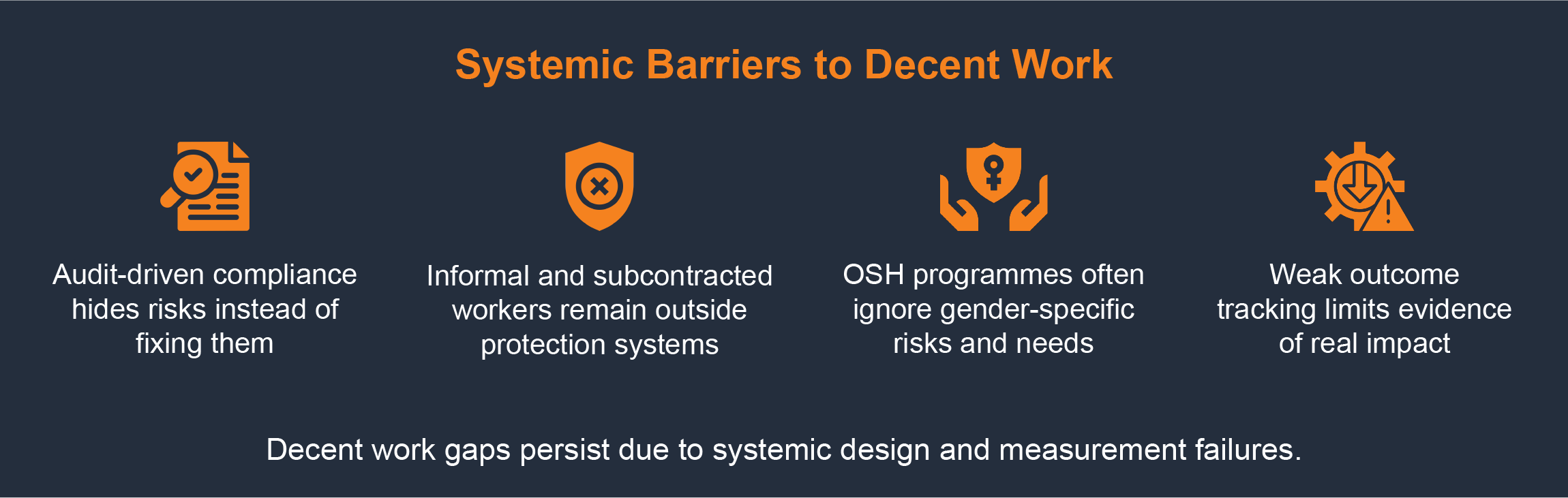
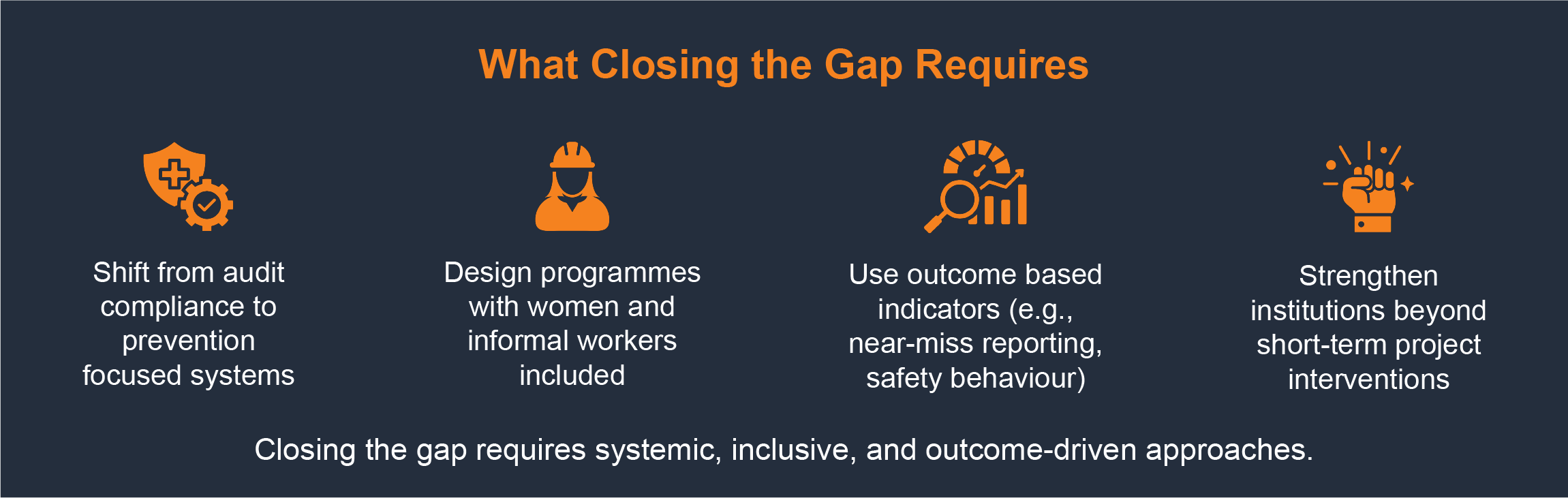
The barriers above are systemic. Yet, the solutions are not very complex. Workers are usually very clear about what makes work safer and more dignified. The real question is whether systems are willing to listen, measure honestly, and act early.
Prevention before detection. Embed hazard identification into daily workflow rather than waiting for incidents to occur. Make risk-spotting a routine part of how supervisors and workers operate.
Inclusion by design. Women workers and informal sector workers should shape the programmes intended to serve them, not as a token consultation step, but as a substantive input that determines what problems are addressed and how.
Measurement that captures what matters. Leading indicators, including near-miss reporting rates and supervisor safety behaviour scores, are more actionable than lagging ones. Real-time monitoring and rigorous impact evaluation are not optional add-ons. They are what separates programmes that improve from programmes that merely continue.
Systems over projects. The most durable outcomes come from building institutions capable of sustaining change after the project ends, including functional labour inspection capacity, worker representation mechanisms, and employer associations that treat OSH as a business value.
Innovision's Industrial Productivity and Worker Wellbeing (IPWW) portfolio has learned that these barriers can be reduced, but not through checklist solutions. In our experience, the strongest programmes are the ones workers trust enough to use, not just the ones upper echelons of the system are satisfied to report on.
Our work begins with diagnosis: baseline research that maps the actual risk landscape in a given sector, grounded in worker consultations, facility assessments, and institutional analysis. Implementation is built for inclusion, with curricula co-developed with women workers and informal sector participants, and capacity built from factory floor to labour inspectorate. Our M&E systems track behavioural change rather than attendance, and outcomes rather than outputs.
We work alongside the ILO, Swisscontact, and bilateral development agencies across RMG, footwear, salt processing, and smallholder agriculture. Our goal in every engagement is to leave behind something that functions without us.
If this gap between promise and practice is too close, it will require better partnerships, better evidence, and much more grounded programme design.
If your organisation is designing, funding, or scaling programmes in labour rights, occupational safety, or worker wellbeing, we would welcome a conversation. We support partners from sectoral diagnostics and programme design through to M&E framework development and policy-ready research, across South and Southeast Asia.
Get in touch: innovision-bd.com/contact-us
Explore our IPWW portfolio: IPWW Portfolio Profile
.png)