Bangladesh ranks seventh globally for long-term climate risk, and its ready-made garment (RMG) sector sits at the center of that exposure. The industry is one of the country's largest consumers of groundwater and energy, employs a workforce that is majority female, and operates in a country where climate shocks are already disrupting water supply and weather patterns that production depends on.
For most of the industry's history, climate response and worker dialogue have run on separate tracks. Climate decisions, energy audits, effluent treatment, compliance reporting, have sat with management and engineers. Worker dialogue, wages, grievances, safety, has run through participation committees, safety committees, and trade unions. The two structures rarely intersected.
The Green Social Dialogue (GSD) project, funded by the Norwegian Agency for Development Cooperation and implemented by ETI Bangladesh (July 2022 to June 2024), integrated climate action, resource efficiency, and waste management into existing worker-management dialogue structures in RMG factories. As a technical partner from September 2022 to December 2023, Innovision Consulting conducted baseline assessments, developed training modules, and delivered training in four factories. The project demonstrated that engaging workers directly can drive meaningful environmental improvements on the factory floor.
Before designing any intervention, the project assessed knowledge, attitudes, and practices (KAP) across ten candidate factories, surveying workers, committee members, and management on all four thematic areas. Factories were then selected using a weighted scoring model that combined two inputs: the size of each factory's KAP gap, and its readiness to act, measured by whether a functioning social dialogue mechanism already existed, whether management was receptive, and whether prior development partnerships had succeeded.
This sequencing matters. Skill-building delivered without a baseline tends to be generic; skill-building calibrated to a measured gap is targeted. The five factories selected for implementation were the ones most likely to convert training into committed action, not simply the most willing to participate.
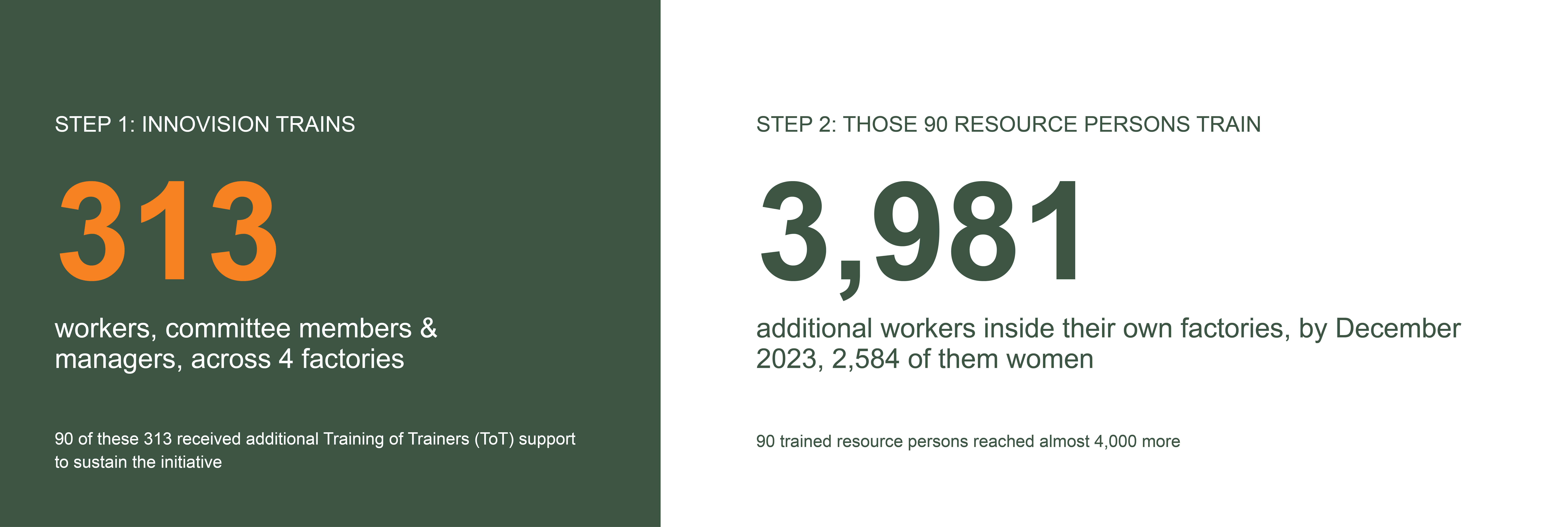
The project delivered three tiers of training, scaled to each group's influence over resource use:
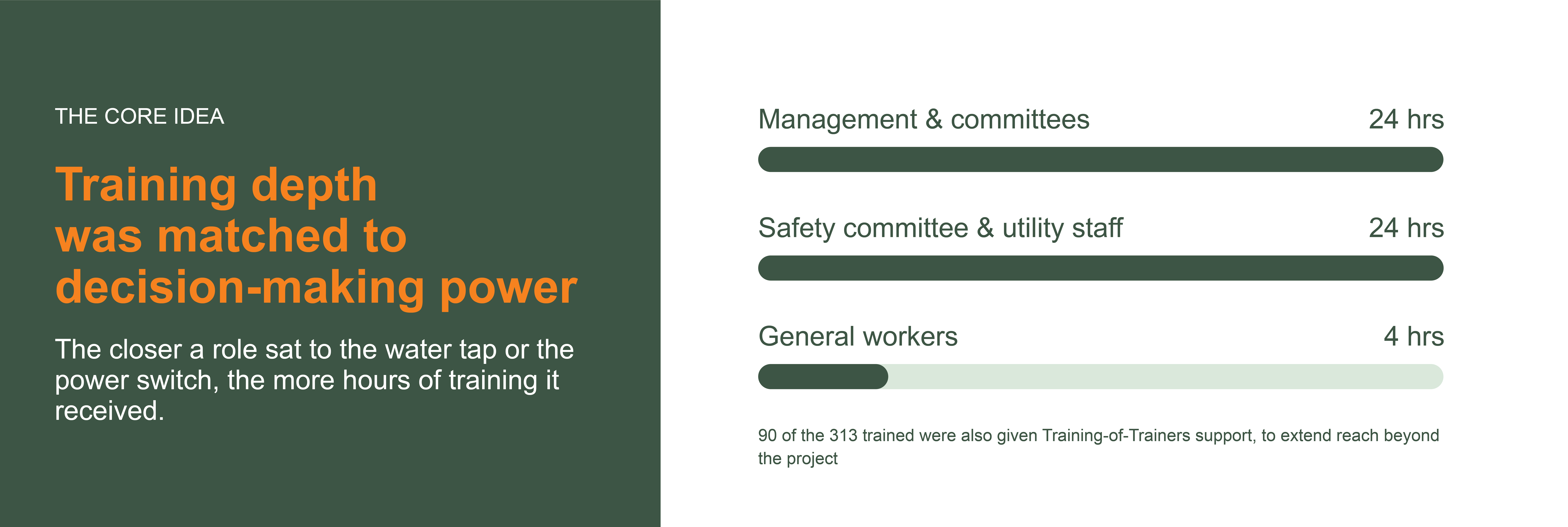
Innovision directly trained 313 individuals across four factories, including workers, committee members, and management representatives. Among them, 90 factory resource persons were selected and received additional Training of Trainers (ToT) support to sustain the initiative beyond the project period. By December 2023, these resource persons had independently oriented 3,981 workers, including 2,584 women, within their factories, demonstrating the effectiveness of embedding environmental knowledge and training capacity into existing workplace structures.
Not every commitment moved at the same pace, and the project's own assessment is direct about where friction emerged. Some factories took longer than planned to execute their action items. Certain interventions, recovering condensate water from air-conditioning units, for instance, consumed disproportionate effort relative to their environmental return, a reminder that visible activity is not the same as meaningful impact. And workers trained secondhand through in-house resource persons did not always receive the same printed materials as the original trainers, limiting how far the knowledge traveled into workers' households.
None of this undermines the model. It defines what the next iteration needs to fix: longer implementation windows for capital-intensive commitments like solar installation, complete training materials for every worker regardless of which trainer delivers the session, and a more disciplined filter for which interventions are worth the resource cost.
The central finding of this pilot is not that training changes behavior, that is the assumption behind most capacity-building programs. It is that the institutional infrastructure required to act on climate change inside a garment factory is already in place. The participation committee, the safety committee, and the monthly union meeting are existing, trusted channels through which environmental commitments can be negotiated and tracked, the same way wage and safety commitments already are.
What was missing was not structure. It was an invitation, a knowledge baseline, and a discipline of converting dialogue into numbers that someone is accountable for delivering.
For an industry that will keep operating at the intersection of high resource consumption and high climate exposure, that is a more replicable model than building new institutions from scratch.
This piece draws on the Project Completion Report on Green Social Dialogue in the RMG Industry in Bangladesh, prepared by Innovision Consulting for Ethical Trading Initiative (ETI) Bangladesh.
.png)