When climate change is discussed in Bangladesh, the focus is often on what is visible: flooded homes, damaged infrastructure, injury, disease outbreaks, and economic losses. These impacts are immediate and measurable.
But beneath them, a quieter and far less visible crisis is unfolding.
For millions of people, climate change is no longer just a physical threat. It is becoming a psychological one.
Bangladesh ranks among the most climate-vulnerable countries in the world and is placed ninth globally in terms of disaster risk (World Risk Report, 2023). Rising sea levels and recurrent flooding could displace up to 13.3 million people by 2050 (World Bank, 2022), while more than half of the population already lives in areas of high climate exposure (USAID, 2018). Between 2000 and 2019, extreme weather events alone caused over $37 billion in economic losses (Eckstein et al., 2021).
These numbers highlight physical damage. They capture loss of homes, livelihoods, and exposure to malnutrition, injury, and disease.
What they do not capture is how this constant exposure to risk is shaping people’s mental well-being.
Living under continuous threat, such as displacement, income loss, food insecurity, or repeated disruption, creates stress that does not fade easily. Over time, this builds into persistent anxiety, depression, and trauma.
Mental health is increasingly being recognized as a critical yet underexplored dimension of climate vulnerability (Goudet et al., 2024; WHO Bangladesh, 2024).

Across Bangladesh, this psychological burden appears in different ways depending on location and exposure.
In flood- and cyclone-prone areas, repeated disasters leave lasting trauma. Evidence from the 2024 flash floods in Cumilla shows that affected households reported significantly higher levels of depression and anxiety compared to non-affected communities (Rahman et al., 2025).
In coastal regions, slow-onset challenges such as salinity intrusion, land loss, and declining agricultural productivity increase food insecurity and malnutrition, which further intensify stress and uncertainty (icddr,b, 2024).
Urban populations face a different but equally serious challenge. In cities like Dhaka, heat waves, poor air quality, waterlogging, and overcrowding are linked to fatigue, irritability, and anxiety, especially among low-income workers (World Bank, 2024).
Across all regions, one pattern is clear. Climate stress is no longer occasional. It is continuous.

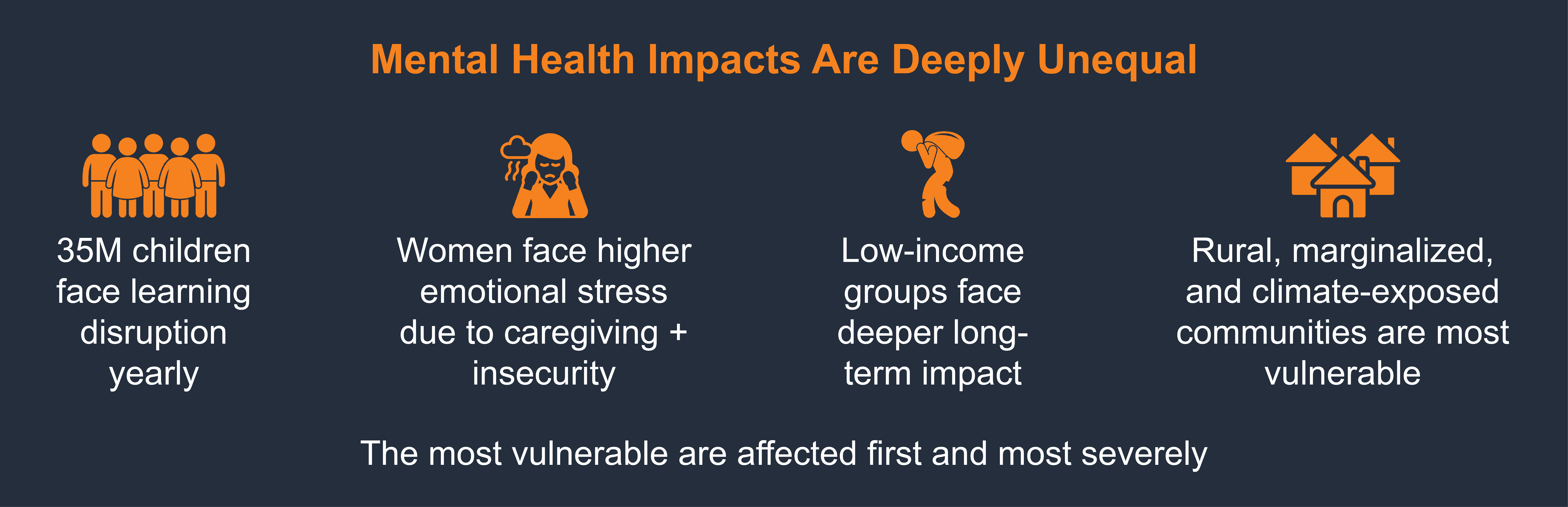
The burden is not evenly distributed. Women often experience compounded emotional stress due to caregiving responsibilities, food insecurity, livelihood loss, and social pressures, particularly when male family members migrate for work (Goudet et al., 2024).
Children and adolescents are also highly vulnerable. Nearly 35 million children face learning disruptions each year due to climate-related disasters (UNICEF, 2025). These disruptions, combined with academic pressure and post-pandemic effects, are contributing to rising anxiety, depression, and loss of motivation. Recent evidence also shows increasing cases of adolescent self-harm and suicide linked to both exam stress and climate shocks (UNICEF, 2025; WHO Bangladesh, 2024).
Rural, marginalized, and climate-exposed communities face even greater challenges due to limited access to healthcare, financial instability, and repeated exposure to shocks.
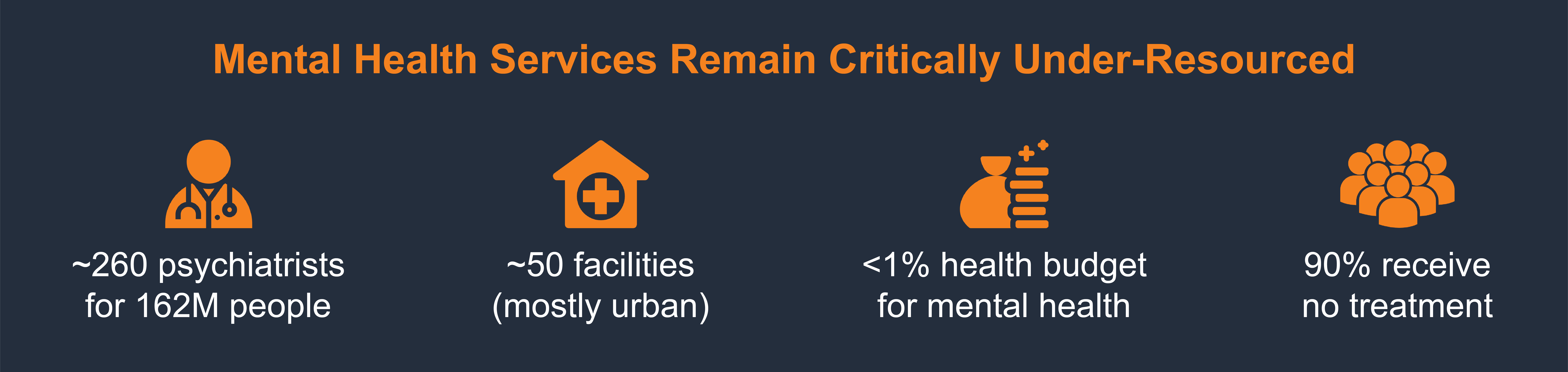
Despite growing need, Bangladesh’s mental health system remains limited.
The country has only around 260 psychiatrists for over 162 million people and about 50 outpatient mental health facilities, most of which are located in urban areas (Hasan MT et al., 2021). Public investment is critically low, with less than 1% of the national health budget allocated to mental health, and over 90% of people receiving no formal treatment (WHO, 2020).
For rural populations, access is even more restricted. Services are often unaffordable, geographically distant, or stigmatized. Many rely on informal care providers who are not equipped to address psychological needs.
This gap directly affects recovery. Mental health is closely linked to resilience. When people struggle psychologically, their ability to rebuild livelihoods, recover from disasters, and adapt to climate change becomes weaker.
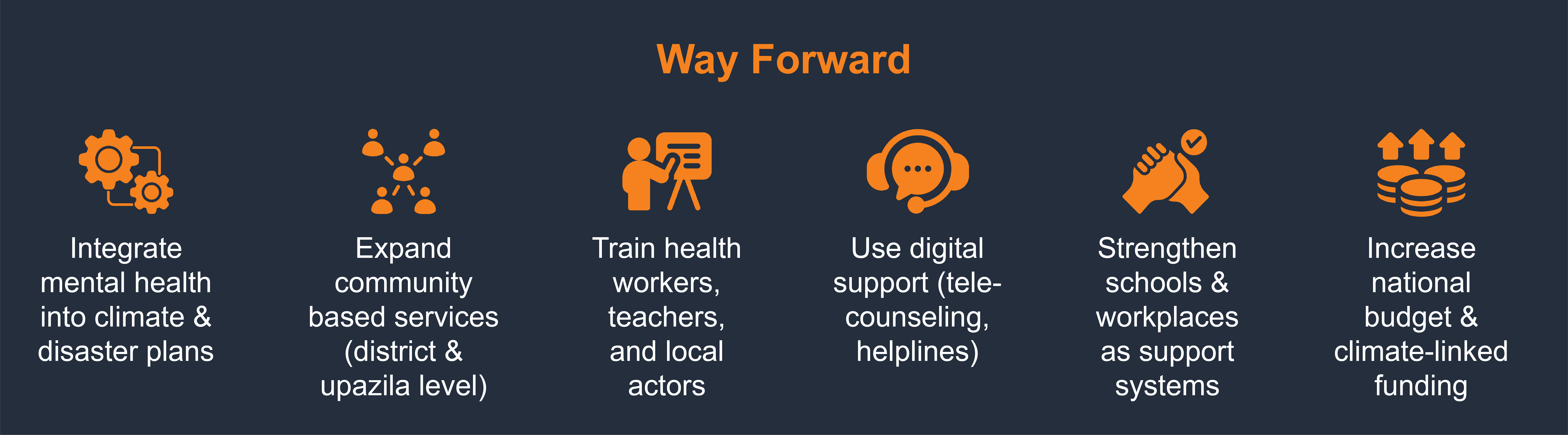
Addressing climate-induced mental health challenges requires coordinated action.
Bangladesh has made strong progress in physical resilience through infrastructure and disaster preparedness. But resilience is not only physical. It is also psychological.
The ability to adapt, recover, and rebuild depends on mental well-being. Addressing mental health is therefore not optional. It is essential.
Because while climate change reshapes landscapes, its most lasting impact may be how it reshapes the human mind.
[1] World Risk Report. (2023). WorldRiskReport 2023.
https://weltrisikobericht.de/wp-content/uploads/2024/01/WorldRiskReport_2023_english_online.pdf
[2] World Bank. (2021/2022). Groundswell Part 2: Acting on Internal Climate Migration.
https://openknowledge.worldbank.org/entities/publication/2c9150df-52c3-58ed-9075-d78ea56c3267
[3] USAID. (2018). Climate Risk Profile: Bangladesh.
https://www.climatelinks.org/resources/climate-risk-profile-bangladesh
[4] Eckstein, D., Künzel, V., Schäfer, L. (2021). Global Climate Risk Index 2021. Germanwatch.
https://www.germanwatch.org/en/19777
[5] WHO. Mental Health in Bangladesh.
https://www.who.int/bangladesh/health-topics/mental-health
[6] WHO Bangladesh. Publications.
https://www.who.int/bangladesh/about-us/publications
[7] icddr,b. Climate Change, Health, and Population Science.
https://www.icddrb.org/climate-change-health-and-population-science
[8] UNICEF. (2025). Learning Interrupted: Global Snapshot of Climate-Related School Disruptions in 2024.
https://www.unicef.org/reports/learning-interrupted-global-snapshot-2024
[9] UNICEF Bangladesh. (2025). 35 million children in Bangladesh had schooling disrupted by climate crises in 2024.
https://www.unicef.org/bangladesh/en/press-releases/33-million-children-bangladesh-had-schooling-disrupted-climate-crises-2024unicef
[10] Hasan, M. T., et al. (2021). Mental Health System in Bangladesh: Challenges and Opportunities.
https://bmcpsychiatry.biomedcentral.com/articles/10.1186/s12888-021-03273-0
[11] WHO. (2020). Mental Health Atlas 2020.
https://www.who.int/publications/i/item/9789240036703
[12] British Asian Trust. Mental health programme page.https://www.britishasiantrust.org/our-work/mental-health/
Author: Nayem Ahmed Siddik, a Senior Associate in the Gender and Basic Services Portfolio at Innovision Consulting
.png)