Across Sub-Saharan Africa, the idea of green transition is often associated with renewable energy investments, climate-smart agriculture, and carbon markets. Yet the real constraint is not conceptual; it is human capital. The shift from chronic vulnerability to sustainable livelihoods is no longer just about financial aid; it is about the precision of information and the acquisition of future-ready skills. Ambitious green policies will not translate into inclusive economic transformation unless marginalized populations possess the technical and adaptive skills required to participate in emerging green value chains.
In fragile and climate-exposed regions such as Northwest Nigeria, where rising temperatures, dry spells, and erratic rainfall increasingly disrupt agrarian systems (Fact Foundation, 2025), traditional livelihoods are under severe strain, and the question transcends the importance or necessity of green livelihoods and focuses on how the affected population can transition into green livelihoods. This necessitates equipping them with the skills needed for resilience and mitigation. Vocational training therefore, occupies a structural position in green livelihood pathways: it converts environmental policy into employability, productivity, and resilience at the household level and, in the long-term, at the societal level.
The global shift toward a green economy, which emphasizes sustainable practices and renewable energy, necessitates a new framework for poverty reduction. Vocational training is the engine of this transition, equipping marginalized populations with the technical competencies needed to thrive in emerging sectors.
Although all the activities listed above are green livelihood activities, the International Labour Organization (International Labour Organization, 2018) defines green jobs as work that is:
Decent jobs that reduce the consumption of energy and raw materials, limit greenhouse gas emissions, minimize waste and pollution, protect and restore ecosystems and enable enterprises and communities to adapt to climate change
This means it includes work in several sectors such as agriculture, manufacturing, construction, and services, provided it reduces environmental impact while ensuring labor standards. That stated, from a market systems perspective, green livelihoods would operate in value chains such as:

These livelihood opportunities require specific competencies, and without structured vocational pathways, the green sectors would remain capital-intensive rather than labor-intensive.
Reports consistently show that skills shortages constrain green transitions in developing economies. A joint study by the World Bank, the ILO, and UNESCO highlights that the technical and vocational education and training (TVET) systems in many low- and middle-income countries are under-resourced, misaligned with skills and labour market demand, and unprepared to meet the demand for TVET (World Bank, ILO, and UNESCO, 2023). Meanwhile these climate shocks are eroding traditional livelihood models, particularly rain-fed agriculture, we find that:
In Northwest Nigeria, for example, transitioning farmers into CSA practices such as drip irrigation and drought-resistant seed systems requires more than awareness campaigns. It demands applied, competency-based training that integrates agronomic knowledge, climate risk literacy, and market linkage skills. Vocational training thus becomes both a resilience strategy and an employability intervention.
A critical but underappreciated challenge in rural Africa is that marginalized populations are often invisible in the data systems that inform policy, excluded from surveys and labour statistics due to geographic isolation and displacement (EDI Global). This invisibility compounds the skills gap: if vulnerable populations are not counted, they are not planned for. Effective vocational programs begin to close this gap by:
A common concept in the economic development landscape is the increased number of short-term training workshops, which tend to be devoid of market demand, and these do not result in sustainable income gains. Study shows that more is achieved when skills training is paired with capital provision and market linkages, (Blattman, and Ralston, 2015). For vocational training to genuinely anchor green livelihood pathways, it must move beyond vague instruction and function as climate adaptation infrastructure thereby shifting from income generation activities that are climate sensitive to those that are climate-adaptive and resilient.
At its core, effective green vocational training is not a social add-on, but a resilience investment embedded within labor market systems, which would include the following key design principles:
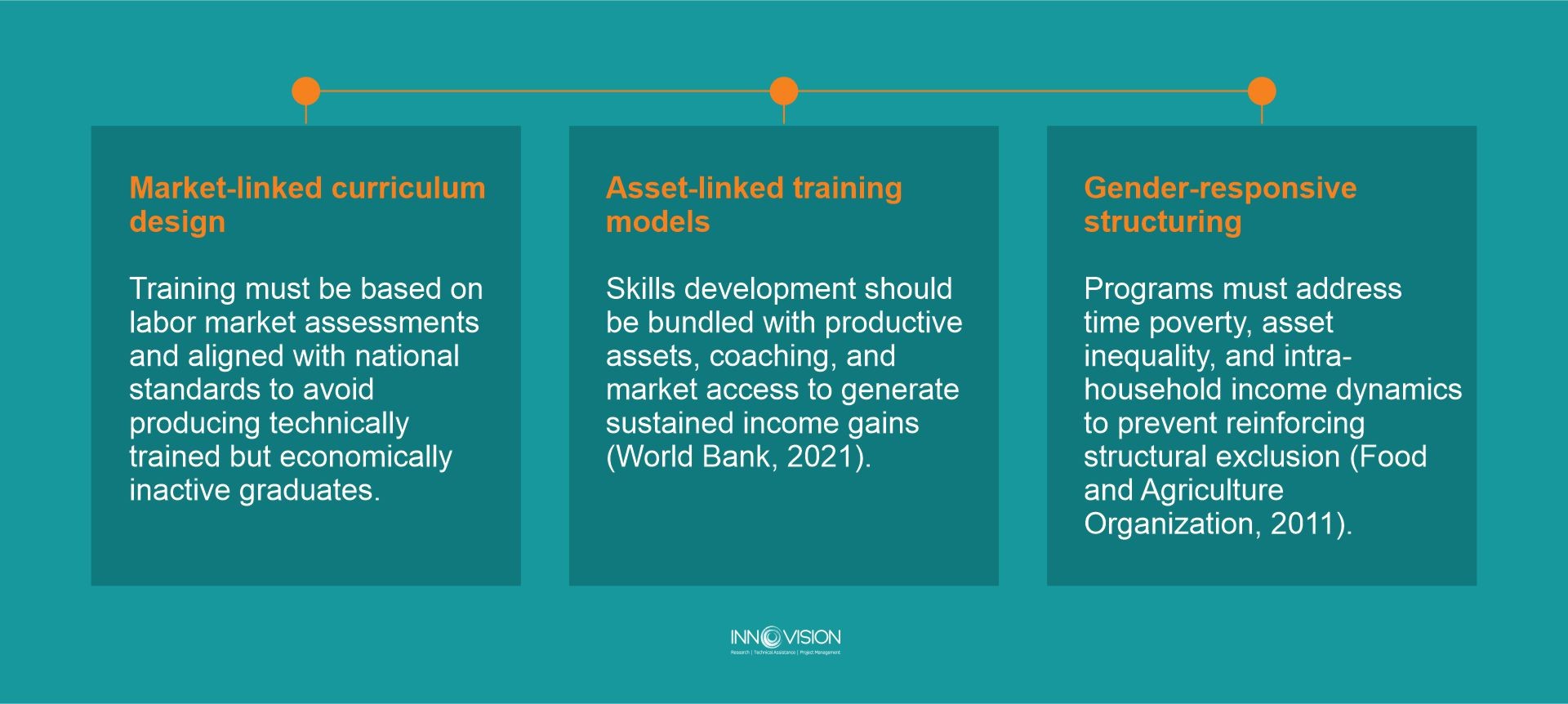
When these principles are embedded together, vocational training ceases to be a standalone intervention and becomes what green economic transformation actually requires: a structured, human-centred pathway from climate vulnerability to sustainable livelihood.
Green economic transformation is often narrated through the lens of infrastructure, finance, and policy reform. Yet the key variable remains human capability. Vocational training translates climate ambition into lived economic opportunity. When designed as part of an integrated livelihood pathway, market-linked, asset-supported, gender-responsive, and institutionally aligned, it becomes a structural driver of resilience.
In climate-exposed economies such as Nigeria’s drylands, the future of green livelihoods will not be determined solely by investment flows. It will be determined by whether vulnerable populations are equipped with the competencies to occupy emerging green value chains. Therefore, vocational training is not accessory to the development of the green economy; it is its enabling architecture.
At Innovision, we work at the intersection of climate resilience and inclusive economic systems across Sub-Saharan Africa. If you are designing green livelihood programs, workforce development interventions, or climate adaptation strategies, we would welcome the conversation. Reach out to us at office@innovision-bd.com to explore how we can support your work.
Key sources informing this piece include the ILO World Employment and Social Outlook (2018), the ILO Green Jobs framework (2018), the World Bank/ILO/UNESCO joint TVET report (2023), the World Bank State of Economic Inclusion Report (2021), Blattman & Ralston (2015) via J-PAL, Fact Foundation (2025) on climate impacts in Northwest Nigeria and Moreda (2020) on youth participation in agribusiness.
Other supporting sources: Babban Gona. (n.d.). How Nigerians youths can be engaged through agriculture and EDI Global. (n.d.). The Challenges and Opportunities for Collecting Survey Data in Sub-Saharan Africa. Mathematica.
Author: Chisom Udora, Research Associate, Innovision Consulting Africa
.png)