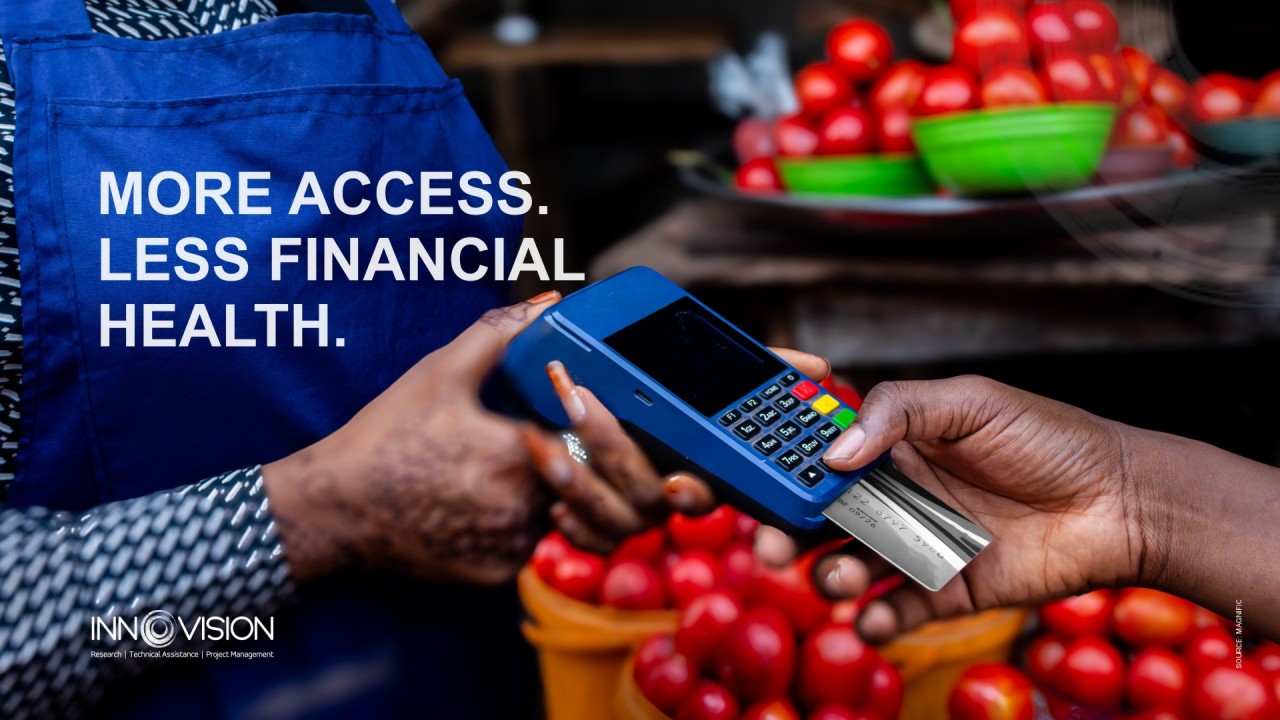
In 2023, Nigeria's financial health rate fell to 16%, even as formal financial inclusion climbed to 64%. More people have accounts. Fewer people are financially well off. That gap between access and meaningful inclusion is the defining challenge of Nigeria's financial inclusion story today.
The headline numbers tell one side of it. Seventy-four per cent of adults were financially included in 2023, up from 68% in 2020. Agent banking expanded from 38,416 registered agents in 2018 to 1.4 million by October 2022. The infrastructure has grown.
But financial health fell from 28% in 2020 to 16% in 2023. That figure should stop us in our tracks.
One under-discussed structural weakness sits at the heart of Nigeria's inclusion delivery architecture: Enterprise Support Organisations (ESOs) are themselves financially fragile.
An ESO Mapping of over 200 organisations across Nigeria, conducted by Innovision Consulting Africa for Impact Investors Foundation (IIF), found that 67% are not financially sustainable and more than 70% are entirely dependent on donor funding. Only 4% offer financial management services, and only 8% offer legal services, yet these are precisely the capabilities MSMEs need to become bankable.
The paradox is stark: the organisations tasked with connecting enterprises to finance cannot sustain themselves financially. This undermines not just individual programmes, but the entire delivery infrastructure for MSME support and financial inclusion.
Nigeria's digital finance potential is significant and growing. The country processed 108 billion mobile money transactions worth US$1.68 trillion in 2024, captured 47% of all fintech deals across Africa, and attracted approximately US$410 million in fintech funding. Moniepoint's unicorn status in October 2024 signals growing investor confidence in Nigerian fintech.
But there is still enormous headroom for deepening beyond payments. A large majority of Nigerians who have phones and accounts are not yet accessing credit, insurance, or savings digitally. The infrastructure is there; the products and the last-mile reach are not yet keeping up.
Agriculture represents another underexplored frontier. Farmers and agricultural workers remain among the most financially excluded groups in Nigeria, yet they represent a vast addressable market for input credit, crop insurance, and climate-adaptive finance, particularly as climate finance becomes a priority for development finance institutions.
And there is growing momentum behind catalytic capital: patient, concessional financing designed to crowd in commercial investment in the "missing middle." With over NGN 1.1 trillion already deployed to more than 700,000 SMEs through impact-aligned channels, the proof of concept exists. What is needed now is scale, deliberate targeting, and better data.
Nigeria's NFIS 3.0 targets 95% formal financial inclusion, a long-term ambition that requires moving from access to depth, quality, and resilience. The headline numbers will not get us there.
What will get us there is a different kind of evidence. Most financial inclusion programmes in Nigeria are designed using national-level estimates or global benchmarks that do not reflect the highly localised nature of exclusion. A smallholder farmer in Kebbi State faces different barriers from a micro-entrepreneur in Enugu or a woman-led VSLA group in Plateau. One-size-fits-all programming consistently underdelivers.
Demand-side diagnostics, consumer surveys, gender-disaggregated studies, MSME ecosystem mapping, ESO sustainability assessments, and market systems analysis are the tools that close the gap between aggregate data and actionable insight. They are also what major ecosystem actors, including EFInA, CBN, FSD Nigeria, UNCDF, IFC, and the Impact Investors Foundation, are actively seeking.
Nigeria is not short of ambition on financial inclusion. What it needs is a sharper, more localised, evidence-driven approach to turning that ambition into sustainable outcomes. The hard work begins with understanding, at the community level, what is actually preventing people from being financially well, not just financially present.
This is exactly the work Innovision Consulting Africa does, and has been doing in Nigeria since 2010. Our recent work includes the ESO Ecosystem Mapping (RISA Fund/UK International Development, 2025) and the Nigeria Impact Investment Landscape Study (IIF/RISA Fund, 2025), which documented NGN 1.1 trillion deployed to over 700,000 SMEs and identified a $31.5 billion annual SDG financing gap. Across 22 countries in Africa and Asia, we have delivered research, financial inclusion, market systems, and private sector development assignments for some of the sector's most demanding clients.
If you are designing a new programme, exploring investment opportunities, or generating evidence to inform strategy, we would welcome the conversation. Reach us at info@innovision-bd.com
What are you seeing on financial health versus financial access in the markets where you work?
Source: Enhancing Financial Innovation & Access (EFInA). Access to Financial Services in Nigeria (A2F) 2023 Survey, Central Bank of Nigeria. National Financial Inclusion Strategy (NFIS) 2022/3.0, GSMA. State of the Industry Report on Mobile Money 2025, PwC Nigeria. MSME Survey 2024, World Bank. Nigeria Development Update 2026, Nigeria's poverty rate climbs to 63% despite easing inflation (World Bank), Impact Investors Foundation & Innovision Consulting Africa. Nigeria Impact Investment Landscape Study (2025) and Enterprise Support Organisation (ESO) Ecosystem Mapping (2025), and Moniepoint reaches unicorn status after $110 million funding round (2024).
Diamond Kanu, Inclusive Financial Solutions Lead, Innovision Consulting Africa
.png)