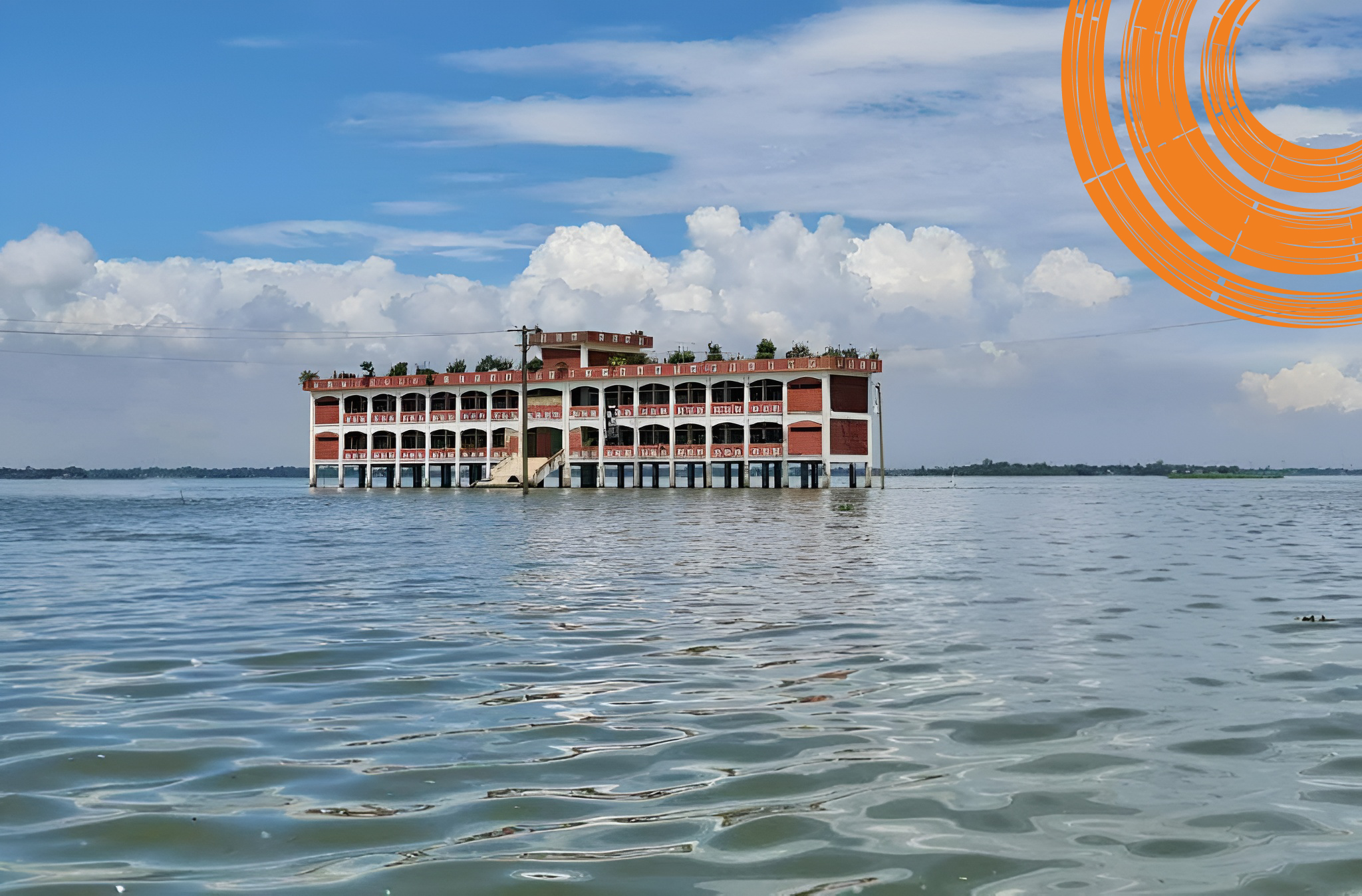
Bangladesh stands at a pivotal moment in its climate finance journey. As one of the world's most climate-vulnerable countries, it faces growing risks from floods, cyclones, salinity intrusion, and extreme weather events while simultaneously pursuing ambitious economic growth and development objectives. The country's National Adaptation Plan (NAP) 2023–2050 estimates that approximately USD 230 billion will be required to implement adaptation and resilience measures over the coming decades, underscoring the urgent need to mobilise private as well as public capital.
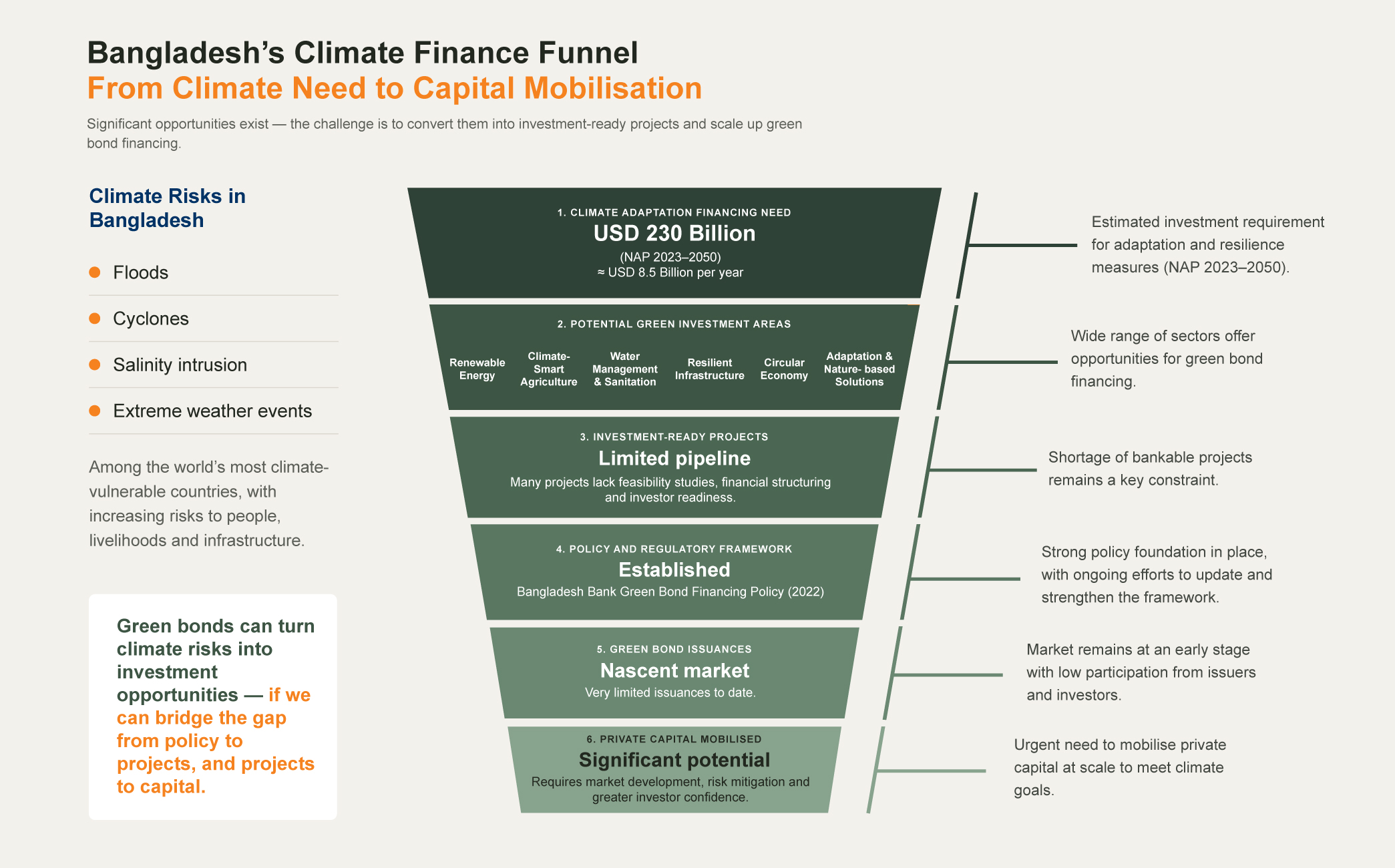
Against this backdrop, green bonds offer a promising mechanism to channel long-term financing toward climate-resilient infrastructure, renewable energy, sustainable agriculture, water resource management, circular economy initiatives, and emerging adaptation investments. Recognising this opportunity, Bangladesh Bank introduced the Green Bond Financing Policy in 2022.
Yet despite these policy advances, Bangladesh's green bond market remains at an early stage. And the challenge is how to transform that framework into a functioning market capable of mobilising climate finance at scale.
A common assumption is that the lack of green bond issuance stems from insufficient regulation. However, global experience suggests otherwise. According to the World Bank, IFC, and ADB, the primary barriers in most emerging markets are not regulatory, but structural. These include limited project pipelines, underdeveloped capital markets, high transaction costs, and insufficient market infrastructure. [worldbank.org], [ppp.worldbank.org], [documents1...ldbank.org], [asianbonds...ne.adb.org]
Bangladesh has substantial financing needs in renewable energy, climate-smart agriculture, water management, waste management, coastal resilience, and climate adaptation, many of these projects are not sufficiently prepared to access capital markets. Project developers often lack feasibility studies, financial models, impact assessment frameworks, and transaction structures that investors require.
Bangladesh remains heavily dependent on bank lending, while institutional investors such as pension funds, insurance companies, and asset managers play a relatively limited role in long-term financing. Without a deep and liquid bond market, sustainable debt instruments face inherent growth constraints. [ppp.worldbank.org], [worldbank.org]
Green bond issuance requires additional layers of project screening, taxonomy alignment, external review, certification, verification, and impact reporting. For large issuers these costs are manageable, but for banks, NBFIs, and mid-sized corporates in Bangladesh they can represent a significant barrier. Research from IFC and ADB identifies verification and reporting costs as one of the most common impediments to market growth across developing economies. [documents1...ldbank.org], [asianbonds...ne.adb.org]
Globally, most green bond proceeds have been directed toward renewable energy, energy efficiency, and clean transportation because these sectors generate predictable cash flows. Bangladesh's most urgent climate needs, however, often relate to resilience, adaptation, and disaster risk reduction. According to the World Resources Institute (WRI), adaptation projects frequently struggle to attract private investment because they generate public benefits rather than direct commercial returns. [wri.org], [wri.org]
Bangladesh is not alone in facing these challenges. Several emerging economies have successfully developed green bond markets by moving beyond policy development and focusing on market creation.
Indonesia provides perhaps the strongest example of sovereign leadership. The government's Green Sukuk programme established market credibility, created benchmark issuances, attracted international investors, and demonstrated government commitment to sustainable finance. Sovereign issuance helped create confidence before expecting widespread participation from the private sector. [asianbonds...ne.adb.org], [worldbank.org]
Malaysia adopted a broader ecosystem approach, combining sustainable finance standards, verification frameworks, market guidance, and capacity-building initiatives. Rather than focusing exclusively on regulations, Malaysia invested in creating a supportive operating environment for issuers and investors. [asianbonds...ne.adb.org], [asianbonds...ne.adb.org]
Thailand emphasised coordination across regulators, financial institutions, stock exchanges, and investors while developing a national sustainable finance taxonomy. This reduced uncertainty and created greater consistency across the market. [asianbonds...ne.adb.org], [asianbonds...ne.adb.org]
India and Egypt demonstrate how sovereign programmes supported by technical assistance can accelerate market development. In both cases, government leadership combined with international advisory support helped establish credibility and create a foundation for future private-sector participation. [worldbank.org], [worldbank.org]
These examples reinforce a common lesson: successful green bond markets emerge not merely from policy frameworks, but from strong pipelines, credible standards, supportive institutions, and active market participants.
Activating the market rather than further expanding policy frameworks.
This highlights the importance of collaboration between international organizations, development partners, financial institutions, and local market enablers. Institutions such as the Climate Bonds Initiative (CBI) bring global standards, certification expertise, and market knowledge, while local actors contribute sector insights, stakeholder networks, and implementation capacity. Together, they create the ecosystem needed to translate climate finance ambitions into investable opportunities.
For Bangladesh, the challenge is no longer identifying barriers to green bond ecosystem development. The priority now is to convert policy reforms and institutional commitments into bankable projects, successful issuances, and sustained private capital mobilisation.
Bangladesh's green bond challenge is not fundamentally a regulatory challenge. We already established many of the building blocks required for sustainable finance, including policy frameworks, taxonomies, disclosure requirements, and regulatory guidance.
The next phase should focus on building a market ecosystem capable of transforming climate priorities into investable opportunities. It’s the time push for creating a market ecosystem, who are capable of transforming climate priorities into investable opportunities. International experience from Indonesia, Malaysia, Thailand, India, and Egypt demonstrates that successful green bond markets are built on five pillars: bankable project pipelines, effective certification systems, active investors, supportive local home grown institutions, and market confidence.
The next phase should focus on building a market ecosystem capable of transforming climate priorities into investable opportunities. This requires stronger project pipelines, market infrastructure, certification systems, investor participation, and collaboration between public institutions, private sector actors, and development partners.
Author: Mostafa Monira Firdouse, Portfolio Lead for ESG, Climate and Sustainable Investment at Innovision Consulting Private Limited.