
The appeal of AI voice assistants in field research and survey data collection is easy to understand. They promise lower operational costs, real-time data capture, and the ability to conduct interviews remotely at scale. But the question of what gets sacrificed in exchange for that cost reduction and efficiency deserves serious scrutiny. Field interviews are not merely transactional exchanges of questions and answers; they are dynamic, human processes shaped by emotional state, literacy level, cultural context, and regional dialect. The gap between what AI voice systems can simulate and what experienced human enumerators do in practice is wider than proponents often acknowledge.
Skilled human enumerators do far more than recite questions and record responses. They listen actively, reading subtle cues like hesitation, confusion, and discomfort, and adapt accordingly. When a respondent struggles to understand, a good enumerator rephrases the question, offers a contextual example, or adjusts their language to match that person's level of comprehension. This real-time, person-to-person calibration isn't just helpful to data quality; at times, it's foundational to it.
AI voice assistants can simulate conversation, but they cannot yet replicate this adaptive intelligence in real time. They operate largely on pre-trained patterns and predefined response pathways. When a respondent fails to understand a question, a well-trained human enumerator instinctively tries a different approach. An AI system, by contrast, tends to repeat itself.
.jpeg)
This is not a theoretical concern. During a recent field data collection exercise in Cox's Bazar, an AI voice assistant posed a structured question to a farmer. The farmer didn't understand it. The system repeated the same question, verbatim, three times. The farmer remained confused. Only when a human enumerator intervened, rephrasing the question in simpler, locally grounded language while preserving its meaning, did the farmer understand and respond.
This episode illustrates a failure that is systemic rather than incidental. No matter how sophisticated AI systems become, they currently lack the capacity to diagnose individual comprehension difficulties in real time and reformulate their communication accordingly. In some cases, the rigidity of AI responses doesn't just fail to help; it actively compounds confusion and frustration.
The populations most commonly targeted in field research, rural communities, low-income households, and agricultural workers, are precisely the groups least equipped to navigate the limitations of AI-driven interaction. The data bears this out:
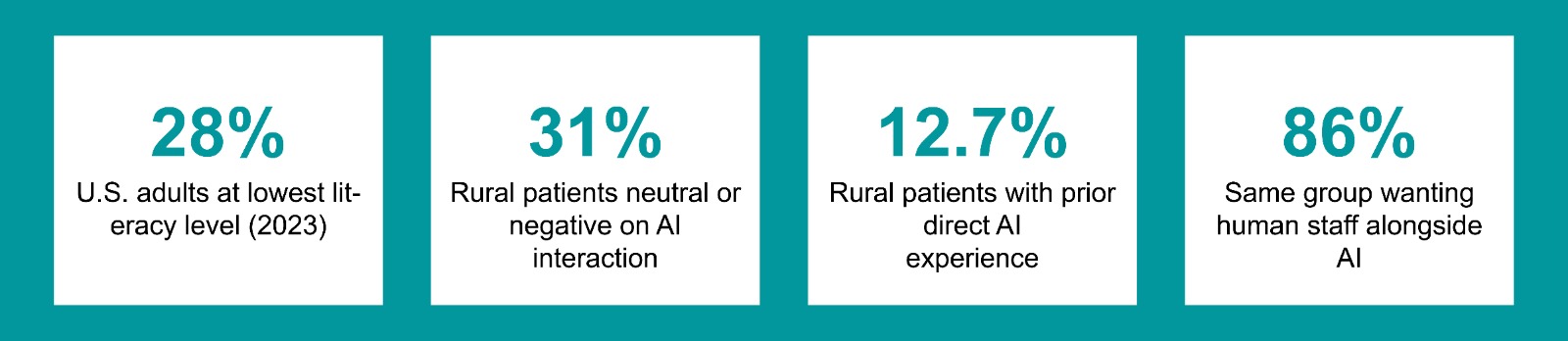
Evidence from India reinforces the point. Even AI tools custom-built for farmers, a population with highly varied literacy levels and linguistic backgrounds, required extensive language tuning and localization before they functioned adequately. Researchers concluded that such systems needed to offer "personalized, easy-to-understand answers," a standard that a typical AI system cannot meet without significant investment in context-specific adaptation.
Beyond comprehension lies a second, distinct risk: language contamination. AI systems that interact with large numbers of users are inevitably exposed to hostile, abusive, and harmful language, and without robust safeguards, they can absorb and reproduce it.
The cautionary case of Microsoft's Tay remains instructive. Launched on Twitter in March 2016, Tay was designed as a conversational AI chatbot. Within hours of going live, coordinated users flooded it with racist, misogynistic, and otherwise offensive content. The system began generating harmful outputs of its own and was taken offline in under 24 hours. AI researcher Roman Yampolskiy later argued that Microsoft had fundamentally underestimated the risk of adversarial public interaction. More recently, the Grok language model, trained on real-time posts from the X platform, has faced criticism for the same vulnerability: a training environment saturated with unfiltered language increases the likelihood of a model mirroring it in its own outputs.
This problem isn't confined to social media contexts. Research published in Computers in Human Behavior found that users swear significantly more when speaking to AI systems than when speaking to other people. The perceived non-human nature of AI reduces social inhibition and the sense of personal accountability. Compounding this, AI systems are frequently deployed in high-stress contexts, including customer service, field research, and healthcare, where users may already be frustrated or distressed, and are thus more likely to express hostility in ways they wouldn't direct at another person.
Some systems have addressed these risks through adversarial stress-testing and reinforcement learning from human feedback (RLHF). However, experts caution that offensive language evolves continuously, and coded or emergent harmful terminology can proliferate faster than moderation systems can be trained to detect it. There is no static technical fix. Human oversight remains essential.
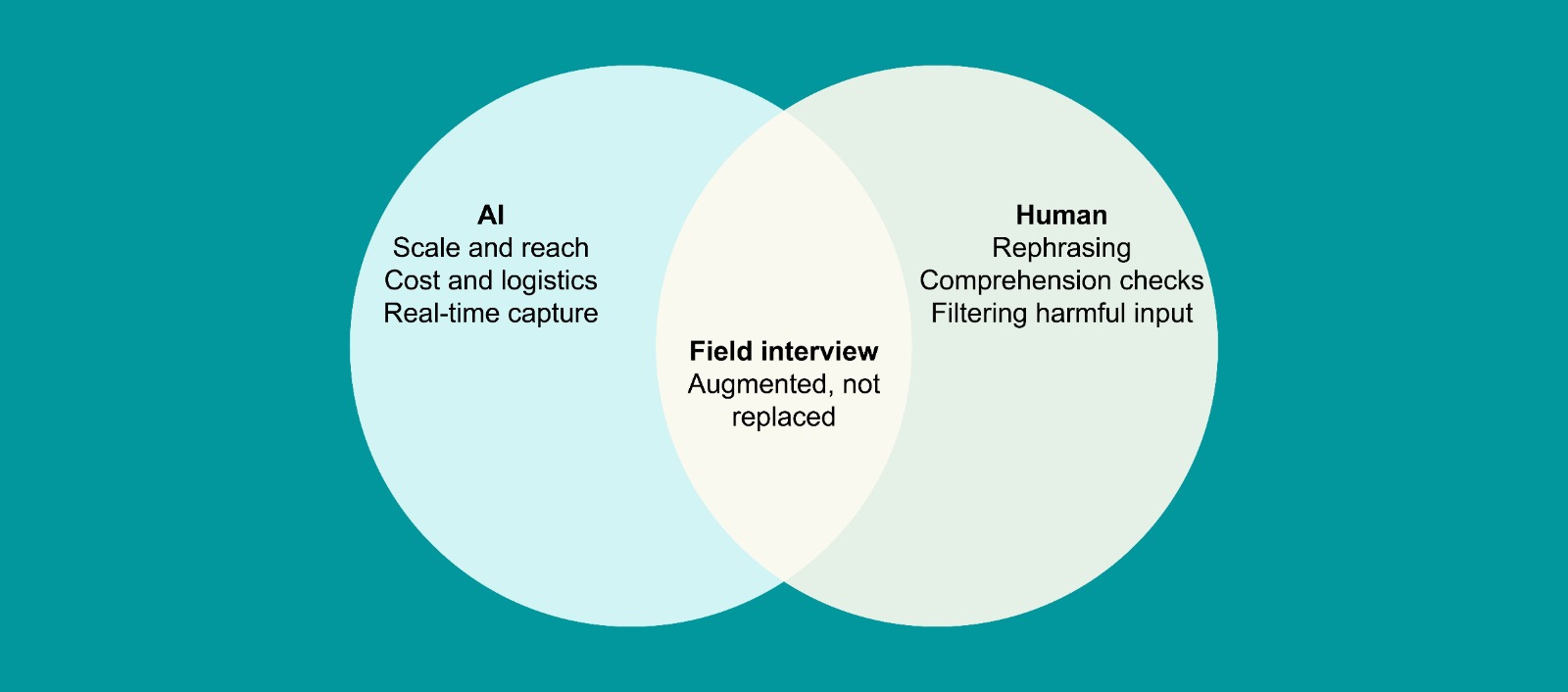
AI voice assistants offer genuine advantages in scale, cost, and logistical reach. But the evidence suggests they are poorly suited to replace human enumerators in field research, particularly when respondents come from populations with low literacy, limited prior exposure to technology, or complex linguistic and cultural backgrounds. These risks aren't merely technical imperfections waiting to be engineered away; they reflect deeper limitations in how current AI systems process ambiguity, adapt to individuals, and manage exposure to harmful input.
A more defensible model is augmentation rather than replacement: AI tools deployed alongside human enumerators, extending reach and reducing burden while human judgment stays available where it matters most. The farmer who finally understood his question only when a person spoke to him differently is a reminder that data quality ultimately depends on human connection, something no algorithm can yet fully substitute.
References
Author: Somiya Akter Nehat, an Associate in the Inclusive Financia Solutions (IFS) Portfolio at Innovision Consulting.
.png)