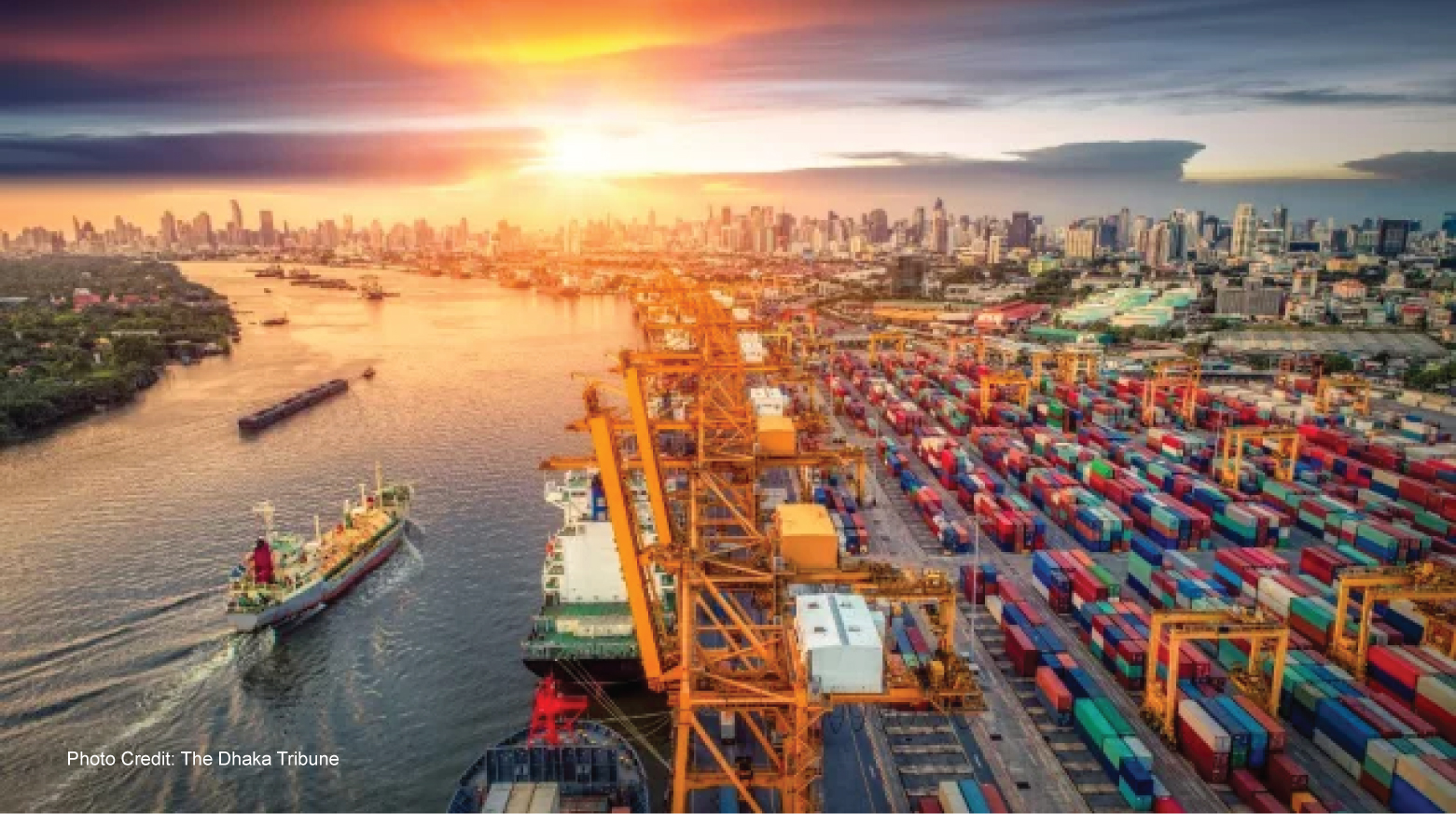
Bangladesh’s logistics and warehousing sector generated more than BDT 3.5 trillion in 2024, accounting for 7.35 percent of the national Gross Domestic Product (GDP) and maintaining a growth rate of 5.14 percent (BBS, 2025). The sector forms the backbone of manufacturing, trade, and export activities, connecting production hubs with domestic and international markets. Despite its importance, Bangladesh ranks one hundredth in the 2023 Logistics Performance Index (LPI), far behind regional competitors such as India at forty sixth position (The World Bank, 2023). This contrast between domestic significance and global performance highlights both the challenges facing the sector and the opportunities for strategic reforms.
As Bangladesh prepares for graduation from Least Developed Country (LDC) status in 2026, with aspirations to achieve middle income status by 2031 and developed economy status by 2041, the efficiency of the logistics system will become a defining factor in trade competitiveness (Ginting, Razzaque, and Hasan, 2024). The withdrawal of duty-free regimes will increase export costs, making smooth logistics essential for reducing transit times, lowering operational expenses, and ensuring access to foreign markets (Dappe, Kunaka, Lebrand, and Weisskopf, 2020). Without effective systems, delays and disruptions may hinder economic progress. The coming decade will be shaped by how effectively Bangladesh implements policies, attracts investment, and strengthens institutional coordination.
Despite global shocks including the Coronavirus Disease 2019 (COVID 19) pandemic and geopolitical tensions, the sector maintained steady growth and supported export-oriented industries such as ready-made garments (Ahmed, 2024). Technology adoption offers further potential, with opportunities to integrate digital tracking, advanced warehouse systems, and automation across supply chains (Shuvo, Habib, and Raisa, 2024). Bangladesh’s major ports, especially Chattogram and Mongla, currently handle ninety two percent of international trade, while Matarbari and Payra are expected to play increasingly significant roles in future trade expansion (Saha, 2024; Ibrahim and Xuefeng, 2023).
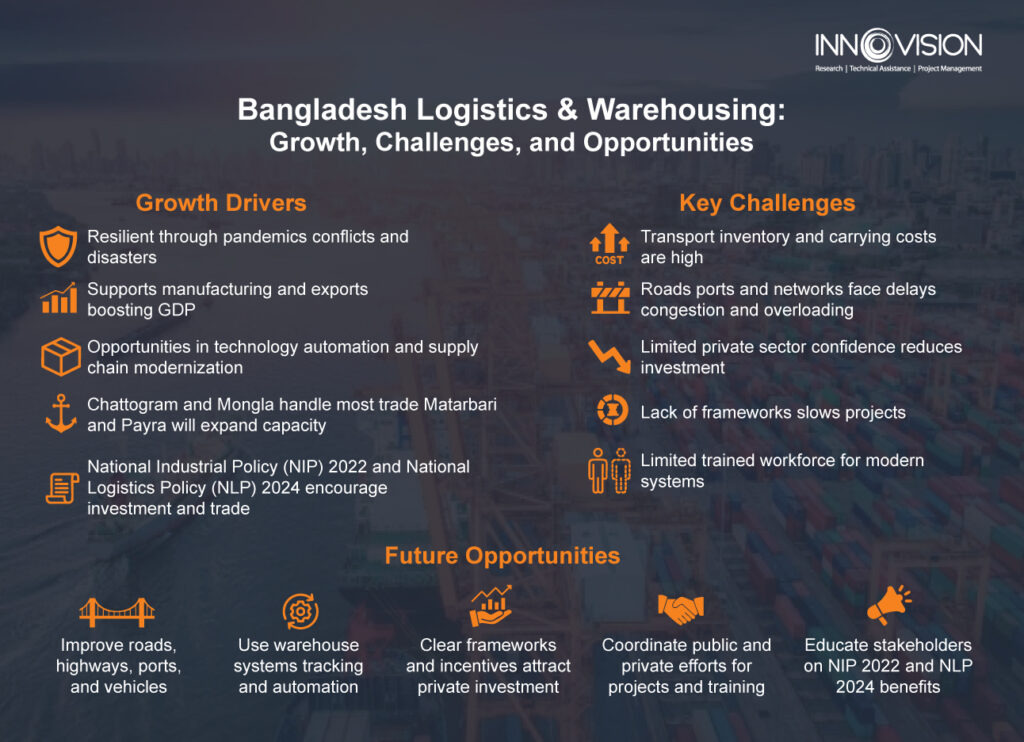
Government policies have introduced clearer direction for sector development. The National Industrial Policy (NIP) 2022 positions logistics as a driver of economic growth, offering incentives such as duty waivers on capital imports and eligibility for Industrial Import Registration Certificates for priority industries (Saha, 2024). The National Logistics Policy (NLP) 2024 establishes a coordinated framework to reduce costs, improve service quality, and attract foreign direct investment. The formation of the National Logistics Development and Coordination Committee (NLDCC) in 2024 aims to align public and private stakeholders, ensuring coherent implementation of policy priorities.
Several structural challenges continue to restrict the full potential of the sector. Logistics costs remain high compared with peer economies, driven by transport delays, inventory expenses, and elevated carrying costs (Dappe, Kunaka, Lebrand, and Weisskopf, 2020). Road networks face chronic congestion, vehicle overloading is common, and natural disruptions frequently slow the movement of goods. Limited adoption of information technology (IT) systems and weak monitoring infrastructure result in longer lead times and reduced supply chain visibility (Shuvo, Habib, and Raisa, 2024). Multimodal transport remains underdeveloped, and congestion at ports creates additional bottlenecks (Ibrahim and Xuefeng, 2023).
Skill shortages further limit the sectors’ ability to adopt advanced technologies, while administrative complexities increase delays (Saha, 2024). Weak public private partnership (PPP) frameworks discourage private investment, with uncertainty over risk sharing mechanisms reducing investor confidence (Dappe, Kunaka, Lebrand, and Weisskopf, 2020). Although robotics, automation, and digital systems could improve performance, implementation remains hindered by limited training, research capacity, and institutional readiness (Shuvo, Habib, and Raisa, 2024).
Despite these constraints, the sector offers substantial opportunities for modernization and growth. Infrastructure development remains a priority, including highway upgrades, axle load management, and improved traffic systems (Saha, 2024). Greater adoption of digital tracking tools in warehouses and logistics fleets can improve visibility and reduce delays (Shuvo, Habib, and Raisa, 2024). A clearer PPP framework could unlock private capital by reducing perceived risks and clarifying long term investment structures (Dappe, Kunaka, Lebrand, and Weisskopf, 2020). Strengthening training and technical education would support a workforce capable of managing advanced logistics systems (Shuvo, Habib, and Raisa, 2024).
Public and private co investment in research on technology, infrastructure, and productivity could guide smarter decision making (Saha, 2024). Increased awareness of the NIP 2022 and the NLP 2024 can help firms better understand available incentives and compliance procedures, ultimately improving sector wide performance.
Bangladesh’s logistics and warehousing sector already plays a central role in trade and manufacturing, and it will become even more critical as the country transitions out of LDC status. Efficient logistics can lower costs, shorten delivery times, and strengthen global competitiveness. Persistent inefficiencies, however, risk slowing economic growth and weakening export performance. Effective policy implementation, sustained investment, and coordinated action across institutions will determine whether this sector becomes a catalyst for Bangladesh’s economic transformation or a constraint that limits its progress.
References
- Ahmed, A. (2024). The Freight and Logistics Industry’s Influence on Economic Growth: The Bangladesh Perspective. SSRN.
- (2025). 2024 Bangladesh Statistical Yearbook. Dhaka: Bangladesh Bureau of Statistics.
- Dappe, M. H., Kunaka, C., Lebrand, M., and Weisskopf, N. (2020). Moving Forward: Connectivity and Logistics to Sustain Bangladesh’s Success. Washington DC: The World Bank.
- Ginting, E., Razzaque, M., and Hasan, R. (2024). Export Diversification in Bangladesh: Overcoming Policy Impediments. Asian Economic Policy Review, 20(1), 57 to 75.
- Ibrahim, M., and Xuefeng, W. (2023). Development of Port Logistics Center: Bangladesh Perspective. Journal of Engineering and Management Research, 68 to 74.
- Saha, D. K. (2024). Comprehensive Report on Logistics Sector of Bangladesh. Dhaka: Ministry of Finance.
- Shuvo, T. F., Habib, M. M., and Raisa, R. (2024). Innovative Technologies in Supply Chain Management for Bangladesh’s Readymade Garments Sector. Digital Social Science, 1(2), 1 to 9.
- The World Bank. (2023). Connecting to Compete: Trade Logistics in the Global Economy. Washington DC: The World Bank.
Author: Mashnur Mahbub, an Intern in the Data Analytics & Emerging Frontiers (DAEF) Portfolio at Innovision Consulting