Dhaka’s rickshaw sector is undergoing a rapid and largely unregulated transformation, with battery-powered rickshaws, popularly known as “Bangla Teslas” reshaping urban mobility, livelihoods, and traffic dynamics across the city. As debates intensify around congestion, safety, and informality, new evidence suggests that balanced regulation, rather than outright bans, will be critical for Dhaka’s transport future.
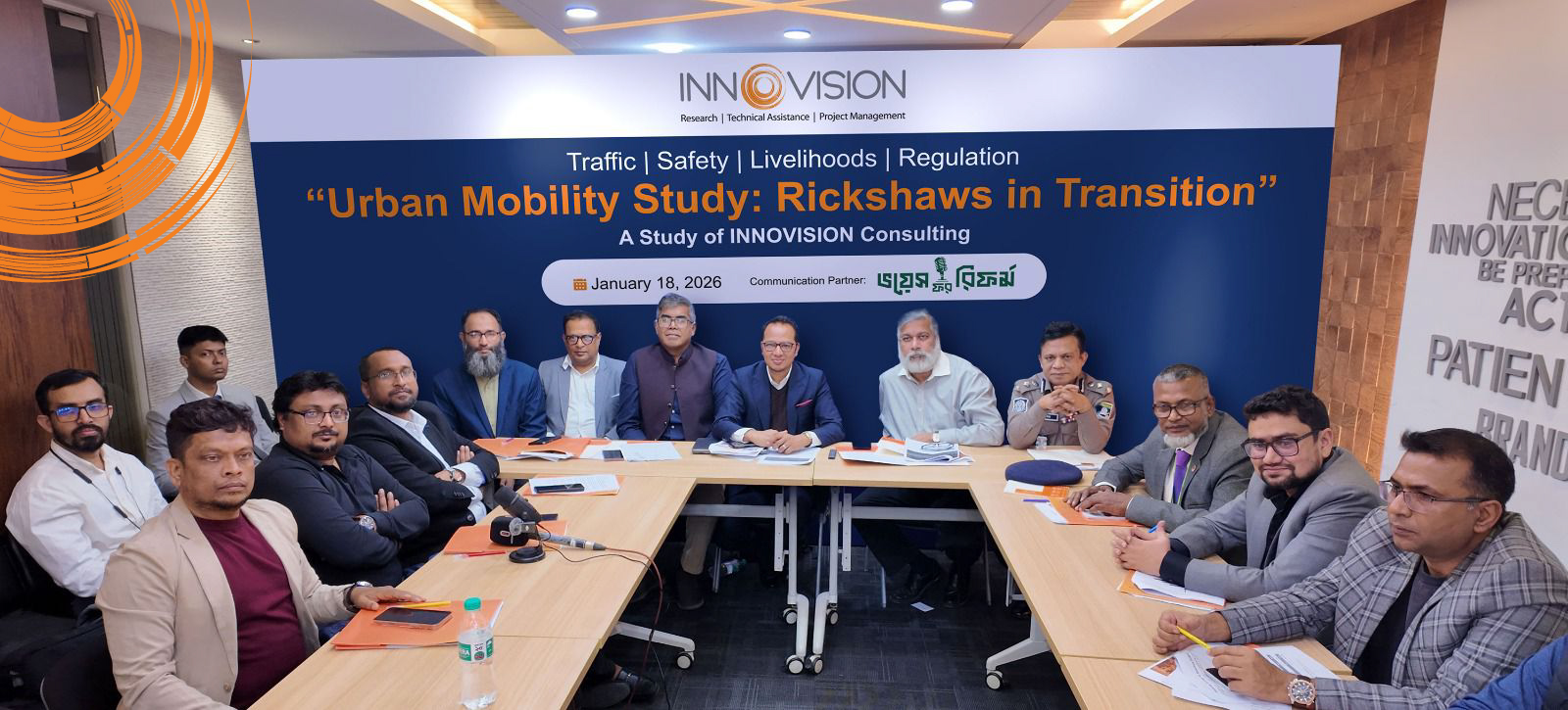
To inform this policy debate, INNOVISION Consulting released its latest research, “Urban Mobility Study: Rickshaws in Transition”, at a dissemination workshop held in Dhaka on 18 January 2026. The event brought together policymakers, transport experts, private sector innovators, civil society leaders, development partners, both padel and battery rickshaw pullers and rickshaw garage owners to examine the implications of Dhaka’s shift from pedal-powered to battery-driven rickshaws.
The study was presented by Md. Rubaiyath Sarwar, Managing Director of INNOVISION Consulting, who outlined key findings drawn from primary data collected from 384 rickshaw drivers, 392 passengers, and 63 garage owners across multiple areas of Dhaka. He noted that the transition to battery rickshaws has generated new income opportunities but has also introduced heightened risks related to road safety, congestion, and financial vulnerability among drivers.
The discussion comes at a particularly critical juncture, as Dhaka North City Corporation (DNCC) and Dhaka South City Corporation (DSCC) have recently launched a joint pilot initiative on BUET designed battery-powered rickshaws. Participants emphasized that without data-driven policy responses, the rapid expansion of battery rickshaws could further strain Dhaka’s already congested road network.
Findings from the study reveal that informality remains pervasive, with over 97% of battery rickshaws and nearly 86% of pedal rickshaws operating outside formal registration systems. Battery rickshaws are attracting a younger workforce, with three-quarters of drivers being new entrants to the sector. While battery rickshaw drivers earn more per day, high rental fees and loan repayments mean rented drivers often take home less money and face higher financial risk.
Passenger perspectives highlighted a clear preference for battery rickshaws due to faster travel and lower daily costs. However, safety concerns were prominent, with a significantly higher incidence and severity of accidents reported for battery-powered rickshaws compared to pedal rickshaws. A majority of passengers identified battery rickshaws as a major contributor to traffic congestion and expressed strong support for stricter regulation.
The dissemination workshop featured diverse perspectives from participants, including Mr. Md. Salim Khan, Traffic Enforcement Officer (Additional DIG) at the Dhaka Transport Coordination Authority (DTCA); Prof. Mosleh Uddin Hassan of BUET; and Dr. Akhtar Mahmud from Jahangirnagar University. Private sector and civil society voices, including representatives from Akij Motors, Solshare, Padakkhep, Casetex, and Shebok, underscored the need for safer vehicle design, improved charging infrastructure, and inclusive financing models.
Participants broadly agreed that policy responses must strike a balance between safety, sustainability, and livelihoods. Recommendations emerging from the study include standardizing battery rickshaw design, regulating entry into the sector while enabling affordable transitions for pedal rickshaw drivers, expanding access to low-cost credit linked to registration, and strengthening driver training and traffic safety awareness. Improving pedestrian infrastructure and developing alternative short-distance mobility options were also highlighted as essential complements to rickshaw regulation.
Concluding the discussion, participants emphasized that rickshaws will continue to play a vital role in Dhaka’s urban transport ecosystem. Ensuring that their evolution is guided by evidence-based, inclusive, and pragmatic policies will be key to maintaining mobility, protecting livelihoods, and improving road safety in one of the world’s most densely populated cities.
Snapshot of this study in English: Click Here
Snapshot of this study in Bangla: Click Here
Report in English: Click Here
Presentation in English: Click Here
Press Release in English: Click Here
Press Release in Bangla: Click Here
Media Coverage of This Study: Kaler Kantho | The Daily Inqilab | The Daily Star | Prothom Alo | Dhaka Tribune | Banik Barta
.png)