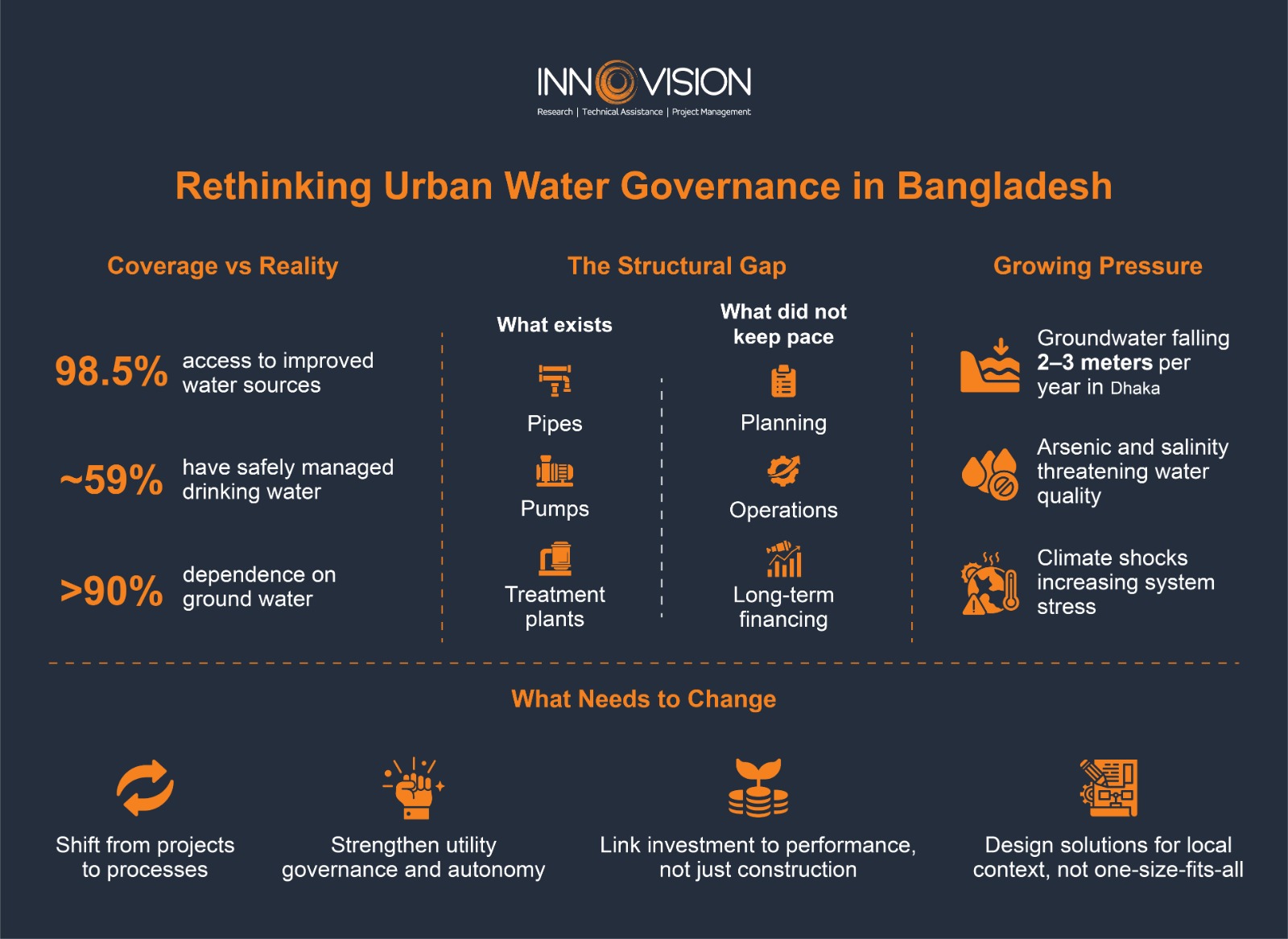
Bangladesh’s urban water systems were designed in a different era, one defined by urgency and expansion rather than climate volatility and institutional sustainability. The central objective at the time was straightforward: extend access as rapidly as possible to a growing population. In many ways, that objective was achieved. Today, 98.5 percent of Bangladesh’s population has access to an improved water source, a milestone that reflects decades of public investment and implementation effort.
Yet the metrics that once signaled success now reveal deeper vulnerabilities.
While access is high, only 59 percent of people benefit from safely managed drinking water when reliability, quality, and continuity are considered together. More than 90 percent of the country’s water supply continues to depend on groundwater extraction, and in Dhaka alone groundwater levels are declining by an estimated two to three meters annually. Arsenic contamination remains a persistent public health concern, while salinity intrusion is intensifying in coastal regions under rising climate pressure.
What emerges from these trends is not a temporary service shortfall but a structural governance challenge. The infrastructure has expanded, but the institutional architecture required to sustain it has not evolved at the same pace.
Over time, Bangladesh has become highly effective at delivering water projects. Pipes have been laid, treatment plants constructed, and service coverage extended to millions. However, the underlying governance model has remained largely project-driven, often fragmented across mandates and reactive to immediate needs rather than anchored in long-term system performance.
Planning for water supply has frequently operated separately from sanitation and wastewater management. Climate adaptation strategies have not always been integrated into urban water planning frameworks. Financing mechanisms have tended to prioritize capital expenditure over operational sustainability. Utilities, while asset-heavy, have often lacked the institutional autonomy and performance frameworks necessary to operate as resilient service providers.
This misalignment across the full water cycle, from source extraction to treatment, distribution, and disposal, creates cumulative risk. Groundwater depletion accelerates. Service reliability becomes uneven. Informal markets emerge to fill persistent gaps. Fiscal pressures increase as systems require rehabilitation sooner than anticipated.
In a delta country, these risks are not isolated sectoral issues. They are economic risks. They shape productivity, urban livability, and climate resilience.
Bangladesh consistently ranks among the most climate-vulnerable countries in the world, and the exposure is not theoretical. Flooding, drought variability, and salinity intrusion are already reshaping water availability and quality. As urbanization accelerates, particularly in Dhaka and other metropolitan centers, demand pressures compound environmental stress.
The decline of groundwater in the capital is a visible indicator of a deeper imbalance between extraction and recharge. When a city depends predominantly on a single resource base, resilience weakens. When sanitation, wastewater, and water supply systems are not planned together, environmental degradation compounds service challenges.
These are not isolated inefficiencies; they are signals that the governance model itself must evolve.
One of the clearest lessons from field experience across Bangladesh is that water stress does not manifest uniformly. In dense informal settlements, exclusion and tenure insecurity complicate service provision as much as physical scarcity. In riverine char areas, seasonal isolation and shifting landforms reshape infrastructure viability. In districts such as Rangamati or Netrokona, centralized systems may be technically or financially unrealistic, requiring locally adapted solutions such as gravity-fed treatment or sand filtration.
Resilience, therefore, cannot be engineered through standardized expansion alone. It must be designed in relation to geography, institutional capacity, and community dynamics. Uniform investment without contextual alignment risks reinforcing fragility rather than reducing it.
As Bangladesh approaches LDC graduation, the financial context surrounding infrastructure investment is shifting. Concessional aid flows are expected to decline over time, while trade, domestic resource mobilization, and performance-linked financing mechanisms become more prominent.
This transition creates both pressure and possibility.
Moving from aid to trade in the water sector is not merely about diversifying financing sources. It requires strengthening the institutional foundations that enable capital to translate into long-term service delivery. Performance-linked investment frameworks demand measurable outcomes. Market-oriented financing requires credible governance structures, regulatory clarity, and operational autonomy.
Through Innovision’s work on sector transition strategies, governance reform, and investment roadmaps, one consistent pattern emerges: funding gaps are often less binding than institutional gaps. Sustainable outcomes materialize when water utilities shift from short-term project cycles toward process-driven operating models that integrate planning, performance monitoring, lifecycle costing, and climate adaptation.
Without that shift, increased capital inflows risk reinforcing structural weaknesses rather than resolving them.
Bangladesh’s vulnerability as a delta nation is frequently described as a constraint. Yet international experience demonstrates that vulnerability can become a catalyst for institutional innovation. Countries that have invested in professionalized utilities, integrated water management frameworks, and long-term climate intelligence systems have transformed exposure into resilience.
Bangladesh now stands at a similar crossroads.
The country has achieved scale in access and demonstrated implementation capacity. What remains is the consolidation of institutional depth. Integrating water supply, sanitation, wastewater management, and climate adaptation within unified governance frameworks is no longer optional. Strengthening utility autonomy and linking financing to measurable performance is not a technical refinement; it is a structural necessity.
The question facing Bangladesh is no longer whether to invest in water. Investment will continue. The deeper question is whether governance models will evolve fast enough to ensure that investment generates resilience rather than recurring vulnerability.
In a climate-exposed delta economy, water security is economic security. The transition from fragmented projects to performance-driven systems may ultimately determine whether Bangladesh trades its exposure for long-term stability.
WHO/UNICEF Joint Monitoring Programme (JMP), Bangladesh – Drinking Water Data, 2023. https://washdata.org/data/household#!/bgd
World Bank, Water in Bangladesh – Sector Overview. https://www.worldbank.org/en/country/bangladesh/brief/water-in-bangladesh
World Bank, Groundwater in Dhaka; Dhaka Water Supply and Sewerage Authority (DWASA), official reports. https://documents.worldbank.org/ https://dwasa.org.bd
World Health Organization, Arsenic Fact Sheet; WHO Bangladesh, Arsenic in Drinking Water. https://www.who.int/news-room/fact-sheets/detail/arsenic https://www.who.int/bangladesh/health-topics/arsenic
World Bank, Climate Risk Country Profile: Bangladesh; Germanwatch, Global Climate Risk Index. https://climateknowledgeportal.worldbank.org/country/bangladesh https://www.germanwatch.org/en/cri
Author: Md. Rihan Hossain, an Associate in the Gender and Basic Services Portfolio at Innovision Consulting
.png)