
Bangladesh’s startup ecosystem is no longer an emerging story on the sidelines of economic growth. It is rapidly becoming one of the country’s most consequential economic frontiers. Over the past decade, startups have reshaped how Bangladesh thinks about innovation, employment, and private sector-led growth. Today, the question is no longer whether startups matter but whether the ecosystem is ready for its next phase of transformation.
Innovision Consulting’s analysis shows that the ecosystem has reached a decisive moment. The foundations are strong, momentum is visible, and policy intent is clearer than ever. Yet without timely structural reforms and strategic coordination, much of this progress risks plateauing just as global and regional competition intensifies.
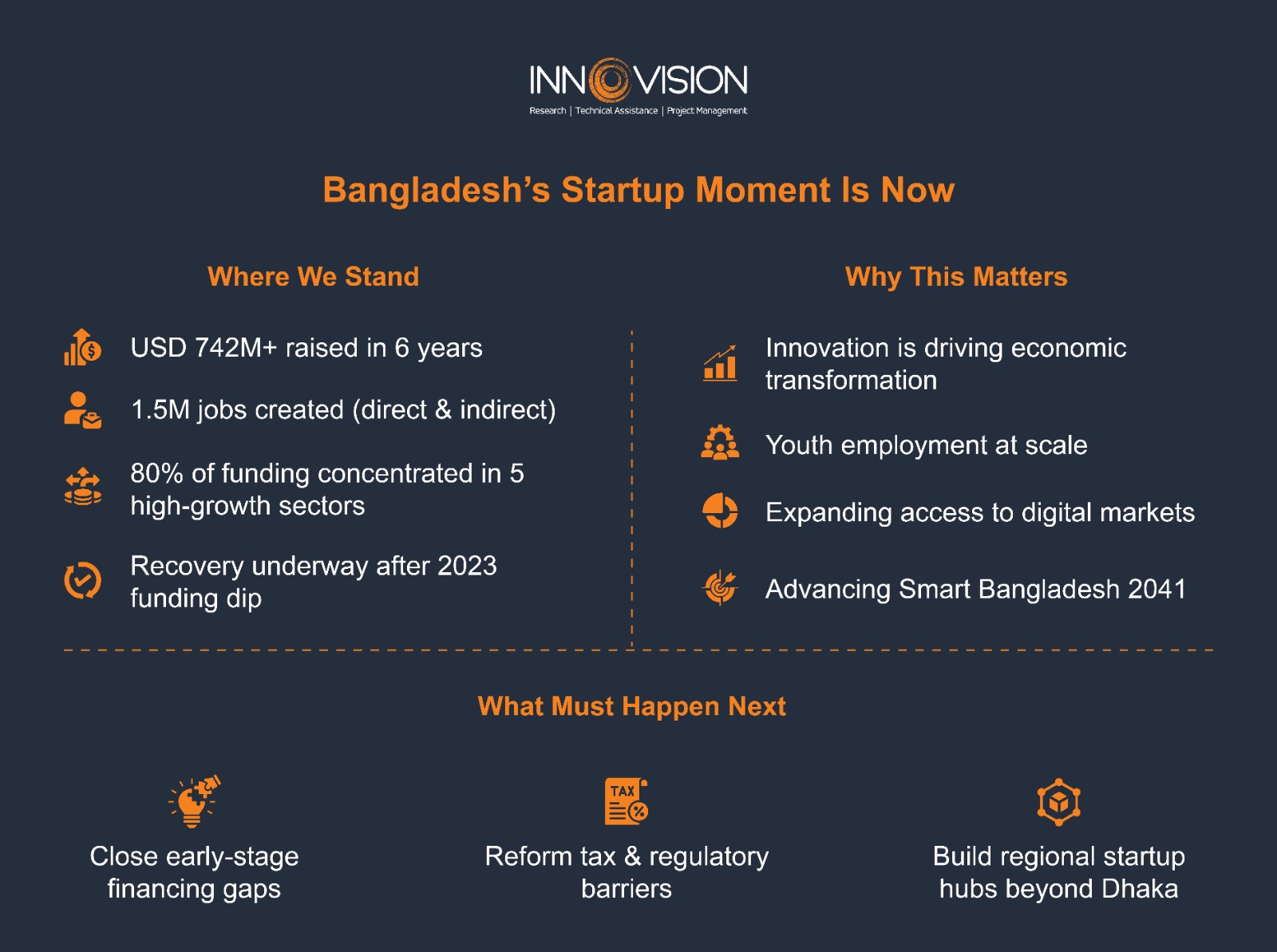
The numbers tell a compelling story. According to the United Nations ESCAP 2022 assessment, Bangladesh’s startup ecosystem secured more than USD 742 million in venture capital and corporate investment over the last six years from both international investors and Startup Bangladesh. Nearly 80 percent of this investment flowed into E-commerce, AgriTech, Mobility, HealthTech, and EdTech – sectors that are now central to daily economic activity.
This surge in investment translated into real economic impact. Startups have generated approximately 1.5 million direct and indirect jobs nationwide – reinforcing their role as engines of employment and inclusion. Even amid global uncertainty, the ecosystem demonstrated resilience. While startup funding declined by 38 percent in 2023, investment rebounded sharply, increasing by 2.5 times by the fourth quarter of the same year.
A defining milestone arrived in 2025 with the merger between ShopUp and Sary, resulting in the creation of the SILQ Group. This deal became the second largest in Bangladesh’s startup history after the bKash and SoftBank collaboration – and signaled that Bangladeshi startups are increasingly capable of operating at regional scale.
At the same time, tax exemptions for technology and IT-enabled companies have acted as a strong incentive for new entrants. With the government extending these exemptions until June 2027 through the Finance Act 2024, startups have gained a more stable fiscal environment in which to plan and grow.
Despite this progress, Innovision’s assessment highlights that growth alone does not guarantee sustainability. Bangladesh’s startup ecosystem continues to face persistent structural constraints that threaten to slow momentum if left unaddressed.
Access to capital remains uneven. Local investors are still limited in number and scale, while foreign venture capital remains cautious. Weak legal protection, inconsistent regulatory guidelines, political uncertainty, and limited coordination between government and private sector actors continue to undermine investor confidence. Although Bangladesh’s sovereign credit rating remains stable at B plus according to S&P and Fitch, and negative at B2 according to Moody’s, these speculative grade ratings act as a disincentive for large-scale foreign venture capital inflows.
High corporate and capital gains taxes outside the IT sector further reduce profitability – discouraging long-term investment. Research by Islam and Manab 2023 reinforces that tax burdens significantly reduce returns for startups, especially during early growth stages.
Beyond financing and regulation, many startups struggle to survive due to internal capability gaps. A recurring challenge is the lack of product-market fit. In many cases, products and services do not fully align with customer demand due to limited market research and imperfect information about consumer preferences.
Weak corporate acumen also contributes to startup failure. Founders often lack exposure to complex business management practices – including market sizing, customer segmentation, supply chain design, and pricing strategies. These challenges are compounded by limited networking opportunities and mentorship, reducing the likelihood that innovative ideas can scale into viable businesses. Bureaucratic hurdles and the absence of startup-specific regulations further constrain growth.
Recent policy reforms suggest that the government increasingly recognizes these challenges. Bangladesh Hi-Tech Park Authority has expanded support through the development of Hi-Tech Parks that offer free rent, electricity, and internet for up to one year – significantly reducing early operational costs.
More notably, Bangladesh Bank introduced a transformative startup financing policy in 2025. This framework allows banks to move beyond traditional lending and make equity investments in startups. Interest rates have been capped at 4 percent, loan limits increased from BDT 1 crore to BDT 8 crore, and age restrictions for founders reduced to 21. Importantly, the policy mandates that at least 10 percent of startup financing be allocated to women entrepreneurs – embedding inclusion directly into financial architecture.
In parallel, BHTPA’s Unibator program is fostering innovation among university students by encouraging them to develop solutions to national challenges. By integrating entrepreneurship into higher education, the program aims to cultivate a new generation of founders equipped with analytical skills and a business mindset.
Despite these advances, Innovision’s analysis identifies one unresolved challenge that continues to shape investor behavior. Exit uncertainty remains a major deterrent. While equity investment is now permitted, investors remain concerned about their ability to sell shares if ventures underperform.
The absence of startup-friendly capital market mechanisms limits investor autonomy and restricts capital recycling within the ecosystem. Developing a stock market framework that accommodates startups, reduces holding periods, and simplifies profit repatriation would significantly enhance Bangladesh’s attractiveness as an investment destination.
As Bangladesh works toward the vision of Smart Bangladesh 2041, the startup ecosystem must expand beyond Dhaka. Concentration of startups in the capital limits inclusive growth and underutilizes the potential of young people in cities such as Chattogram, Rajshahi, and Khulna.
Each year, more than two million youths enter the workforce. Without regionally distributed access to skills development, mentorship, and capital, this demographic dividend risks becoming a missed opportunity. Integrating entrepreneurship into education systems and scaling programs like Unibator across regions can help bridge this gap.
Bangladesh’s startup ecosystem is no longer in its primary phase. It is approaching a moment where strategic choices will determine whether it advances into the top 50 of the Global Startup Ecosystem Index from its current position at 79th or whether it stalls as other emerging economies accelerate.
The future of Bangladesh’s startup ecosystem will be shaped not by isolated incentives but by coordinated reforms that align finance, regulation, education, and capital markets. Those who understand this shift and act now will help define the next chapter of growth. Those who ignore it risk being left behind as the ecosystem moves forward without them.
Author: Humaira Rahman Khan, a Junior Associate in the Data Analytics & Emerging Frontiers (DAEF) Portfolio at Innovision Consulting
.png)